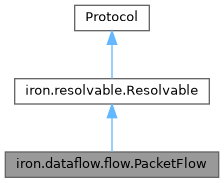
Inheritance diagram for iron.dataflow.flow.PacketFlow:
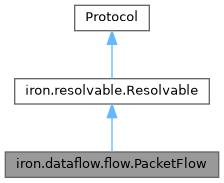
Collaboration diagram for iron.dataflow.flow.PacketFlow:
Public Member Functions | |
| __init__ (self, int pkt_id, src, dst, *WireBundle src_port=WireBundle.DMA, int src_channel=0, WireBundle dst_port=WireBundle.DMA, int dst_channel=0, Sequence[PacketDest] extra_dsts=(), bool keep_pkt_header=False, str|None shim_symbol=None) | |
| int | pkt_id (self) |
| op (self) | |
| all_tiles (self) | |
| None | resolve (self, ir.Location|None loc=None, ir.InsertionPoint|None ip=None) |
 Public Member Functions inherited from iron.resolvable.Resolvable Public Member Functions inherited from iron.resolvable.Resolvable | |
| list | tiles (self) |
Protected Attributes | |
| _pkt_id | |
| _src | |
| _dst | |
| _src_port | |
| _src_channel | |
| _dst_port | |
| _dst_channel | |
| _keep_pkt_header | |
| _shim_symbol | |
| _op | |
| _extra_dsts | |
Detailed Description
An explicit packet-switched route with caller-controlled ``pkt_id``.

Peer of :class:`Flow` for the packet-switched case.  Unlike the
``--packet-sw-objFifos`` global lowering (which auto-assigns sequential
packet IDs to every ObjectFifo in the design), :class:`PacketFlow`
exposes the packet ID directly so the same ID can be reused across
stages and used as a routing decision (e.g. memtile dispatch by
``pkt_id`` to one of several compute cores).

Lowers to a single ``aie.packetflow`` op containing one
``aie.packet_source`` and one or more ``aie.packet_dest`` ops in its
region.
Constructor & Destructor Documentation
◆ __init__()
| iron.dataflow.flow.PacketFlow.__init__ | ( | self, | |
| int | pkt_id, | ||
| src, | |||
| dst, | |||
| *WireBundle | src_port = WireBundle.DMA, |
||
| int | src_channel = 0, |
||
| WireBundle | dst_port = WireBundle.DMA, |
||
| int | dst_channel = 0, |
||
| Sequence[PacketDest] | extra_dsts = (), |
||
| bool | keep_pkt_header = False, |
||
| str | None | shim_symbol = None |
||
| ) |
Construct a PacketFlow.

Args:
    pkt_id: The packet ID — the same byte the routing fabric uses to
        dispatch.  Caller controls the value (often reused across
        stages so a memtile can re-emit packets keeping the original
        ID for downstream routing).
    src, dst: Source / primary destination tiles.
    src_port / src_channel / dst_port / dst_channel: As for :class:`Flow`.
    extra_dsts: Additional destination endpoints if this packet needs
        to fan out.  Each is a :class:`PacketDest`.
    keep_pkt_header: If ``True``, downstream tile receives the 4-byte
        packet header alongside the payload (useful when the receiver
        needs to re-emit with the same pkt_id).  Defaults to ``False``.
    shim_symbol: Same meaning as on :class:`Flow` — auto-emit a
        matching ``aie.shim_dma_allocation`` when one endpoint is a
        shim tile.
Member Function Documentation
◆ all_tiles()
| iron.dataflow.flow.PacketFlow.all_tiles | ( | self | ) |
◆ op()
| iron.dataflow.flow.PacketFlow.op | ( | self | ) |
◆ pkt_id()
| int iron.dataflow.flow.PacketFlow.pkt_id | ( | self | ) |
◆ resolve()
| None iron.dataflow.flow.PacketFlow.resolve | ( | self, | |
| ir.Location | None | loc = None, |
||
| ir.InsertionPoint | None | ip = None |
||
| ) |
Resolve the current object into one or more MLIR operations.
Should only be called within an MLIR context.

Args:
    loc (ir.Location | None, optional): Location is used by MLIR object during construction in some cases. Defaults to None.
    ip (ir.InsertionPoint | None, optional): InsertionPoint is used by MLIR object during construction in some cases. Defaults to None.
Reimplemented from iron.resolvable.Resolvable.
Member Data Documentation
◆ _dst
|
protected |
◆ _dst_channel
|
protected |
◆ _dst_port
|
protected |
◆ _extra_dsts
|
protected |
◆ _keep_pkt_header
|
protected |
◆ _op
|
protected |
◆ _pkt_id
|
protected |
◆ _shim_symbol
|
protected |
◆ _src
|
protected |
◆ _src_channel
|
protected |
◆ _src_port
|
protected |
The documentation for this class was generated from the following file:
- iron/dataflow/flow.py