AMR - CIPS Configuration
CIPS
The processing system (PS), platform management controller (PMC), and CCIX PCIe module (CPM) modules are grouped together and configured using the control, interface, and processing system (CIPS) IP core. The PS contains the APUs, RPUs, and peripherals (I2C, UART, SPI, etc.). It shares the DDRMC with the PL via the NoC. The PMC is responsible for boot and configuration management, power management, reliability and safety functions, dynamic function eXchange (DFX), life cycle management and I/O peripherals. The CPM provides the primary interfaces for designs, such as AMR, following the server system methodology. It has hardened connections to the NoC which is used to access the DDR and other hardened IP. The CIPS configuration is described below. All settings differing from the default settings are indicated in the GUI captures below.
A description of the CIPS configuration options can be found in https://docs.xilinx.com/r/en-US/pg352-cips.
CCIX PCIe Module (CPM5)
CPM5 GUI Configuration
A description of the CPM configuration options can be found here:
CPM5 Basic Configuration
In the CPM5 Basic Configuration window, there are two PCIe Controllers to choose from. When selecting a PCIe controller, AMR follows the same guidance listed here: https://docs.xilinx.com/r/en-US/pg347-cpm-dma-bridge/General-Guidance-for-CPM5. In addition to this, AMR is only using 8 lanes, and to be in PCI SIG compliance, the bottom 8 lanes must be used. As a result, PCIe® controller 1 must be used.
AMR V80 is a Gen 5x8 design supporting 32GT/s raw bandwidth.

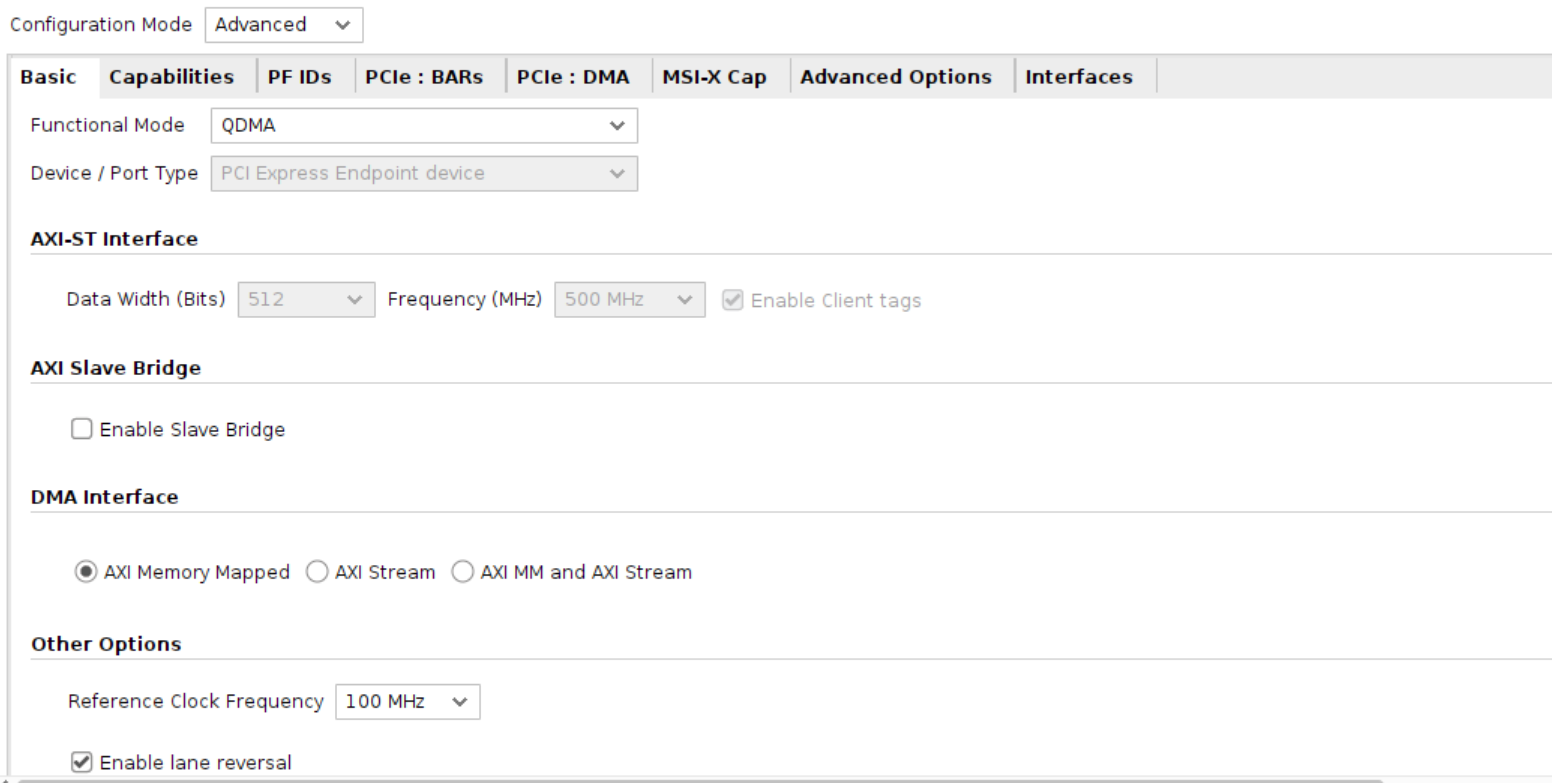
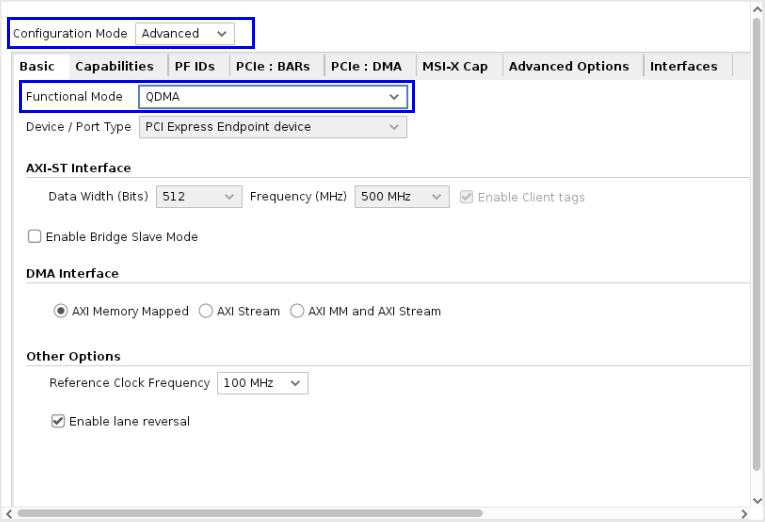
CPM5 PCIE Controller 1 Configuration
Basic
Configuration Mode: Advanced
AMR uses Advanced configuration mode to access MSI-X capabilities and other advanced PCIe features. The mode is set to Advanced to enable the MSI-X cap, advanced options, and interface options GUI tabs.
Current Configuration:
Extended Config Interface (CFG_EXT_IF): Disabled (0)
Extended PCIe Config Space: None (not using extended configuration space)
Note: The current design does not utilize PCIe extended configuration space or vendor-specific extended capabilities (VSEC). To enable these features in future designs:
Set EXT_PCIE_CFG_SPACE_ENABLED to ‘Extended_Large’
Enable CFG_EXT_IF (Extended Config Interface)
Connect to hardware discovery IP for VSEC support
Functional Mode: QDMA
Used for high bandwidth DDR accesses.
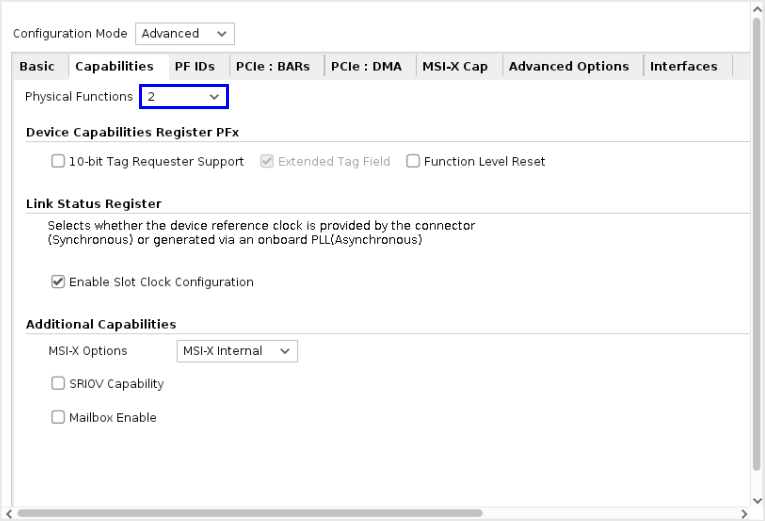
Capabilities
Total Physical Functions: 2
Two Physical Functions (PF) are used in the AMR design. PF0 allows the card to be managed by the PCIe host. PF1 allows DMA transfers with the PCIe Host. Additional PFs can be enabled as required by user applications.
AMR PCIe uses the synchronous clock from the PCIe edge connector.
PF IDs
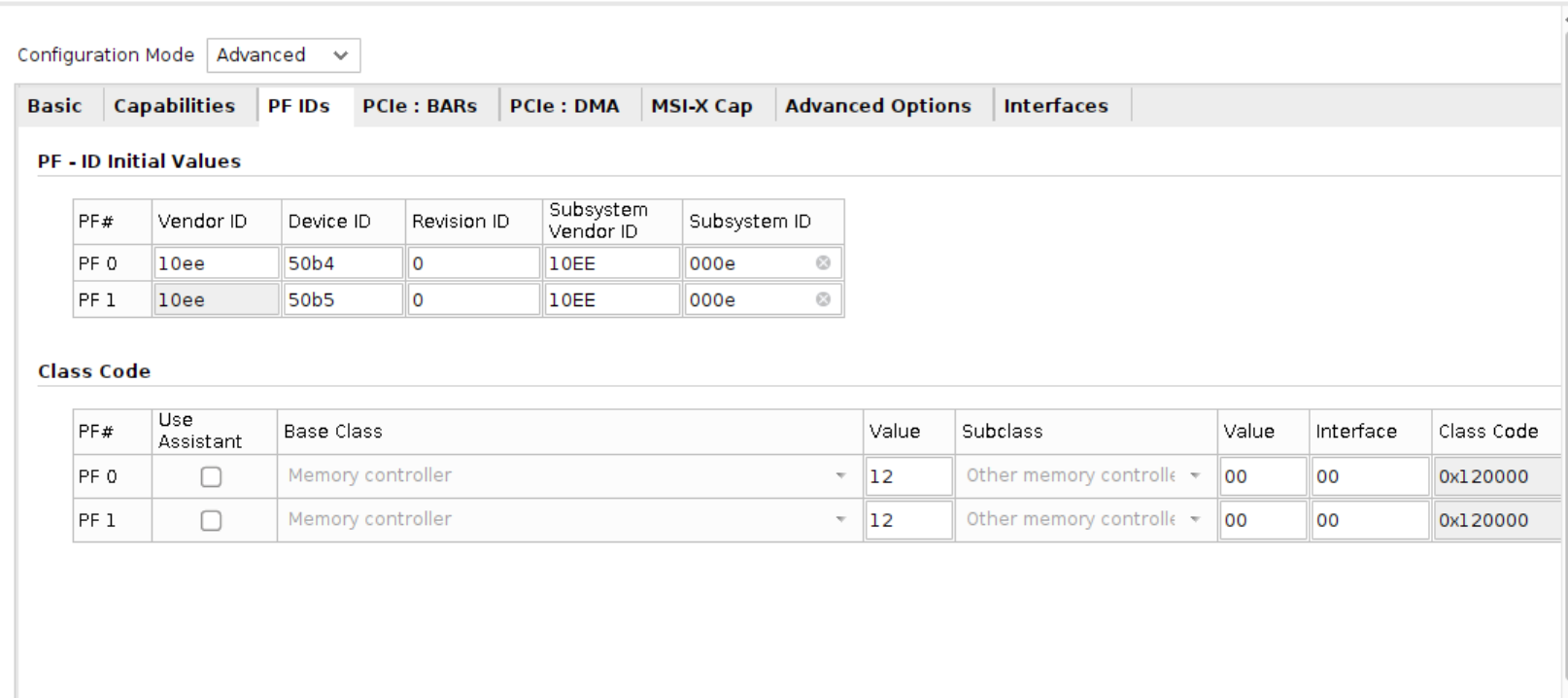
These values must match the settings for the AMR card as indicated in the table below. The greyed out settings are not used by AMR.
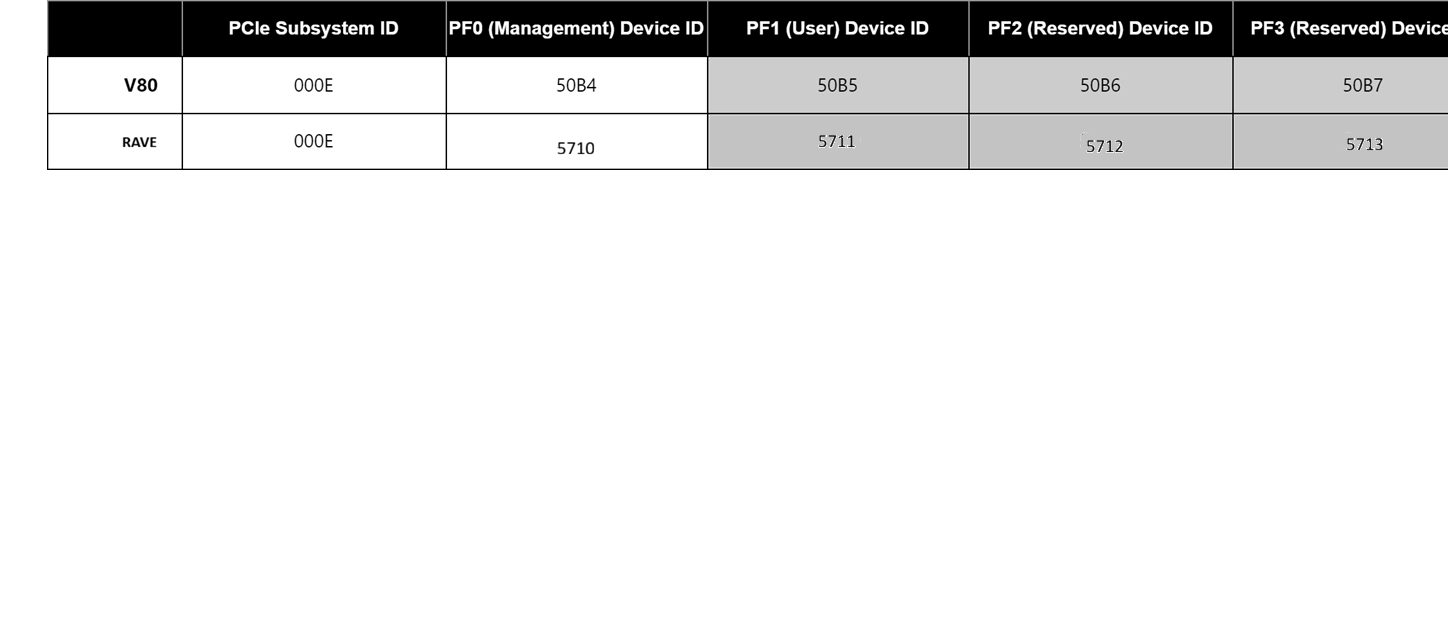
PF - ID Initial Values: Change values to those below to match AMD specific settings
Device ID PF 0
V80: 50b4/50b5
Subsystem ID PF 0: 000e
Class Code: Change values to those below
Base Class Value PF 0: 12 : Processing Accelerator – vendor-specific interface
Subclass Value PF 0: 00 : Processing Accelerator – vendor-specific interface
PCIE: BARs
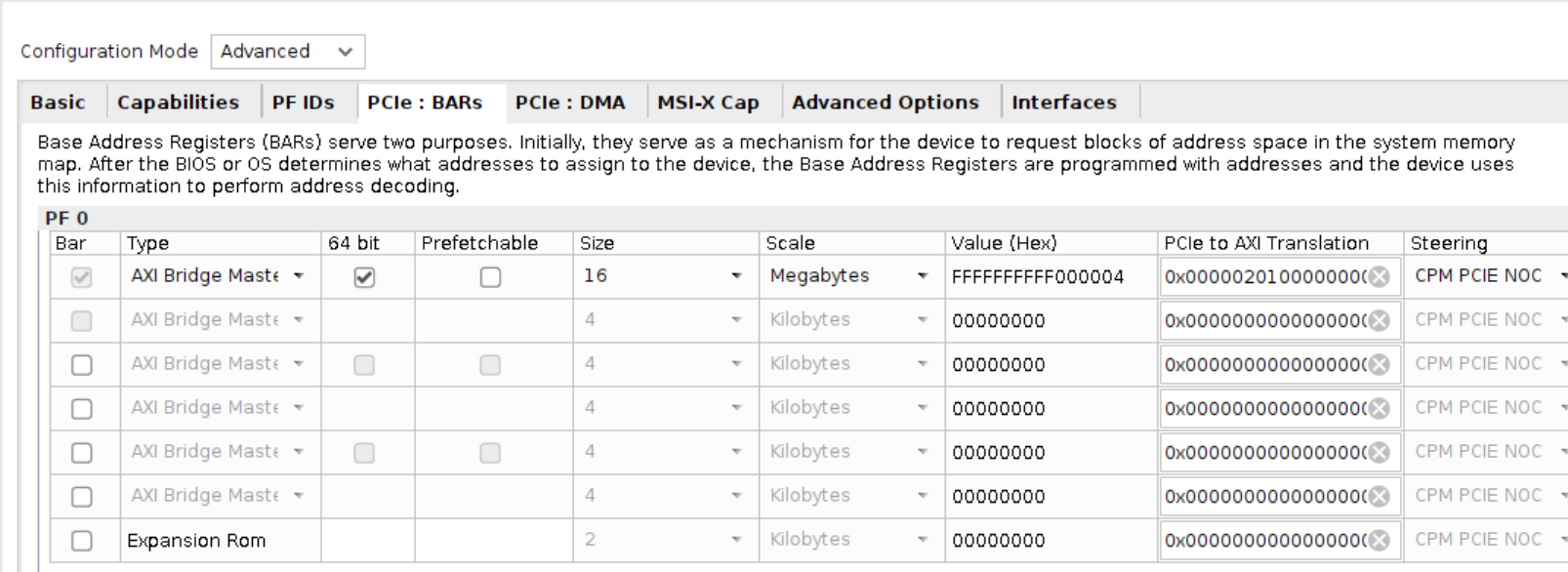
The configuration for the PF0 AXI Bridge Master and PF1 DMA is shown below. These options enable the Master AXI interface within the CIPS IP and is used to interface with AXI peripherals, and also allows for PCIe Host DMA transfers to the memory devices.
CPM5 can support up to six 32-bit BARs or three 64-bit BARs per PF. AMR requires two physical functions:
PF0 Configuration:
BAR0: 8 MB, 64-bit, non-prefetchable, AXI_Bridge_Master
BAR2: Disabled (4 KB configured but not enabled)
Address Mapping: PCIe BAR0 → AXI address 0x0000020100000000
Address Range: 0x201_0000_0000 - 0x201_007F_FFFF (8 MB)
Purpose: Management interface — remapped via NoC to DDR at 0x1000_0000 for GCQ shared memory
PF1 Configuration:
BAR0: 512 KB, 64-bit, prefetchable, DMA
BAR2: 256 MB, 64-bit, prefetchable, AXI_Bridge_Master
Address Mapping (BAR2): PCIe BAR2 → AXI address 0x0000020200000000
Address Range (BAR2): 0x202_0000_0000 - 0x202_0FFF_FFFF (256 MB)
Purpose: DMA transfers (BAR0) and test GPIO access via PL (BAR2)
For additional information on address mapping in AMD Versal™ devices, refer to: https://docs.xilinx.com/r/en-US/am011-versal-acap-trm/16-TB-Address-Map. Since the address space for PCIe and AXI is different, address translation is required and configured through PCIEBAR2AXIBAR registers.
PF0
PCIe: DMA
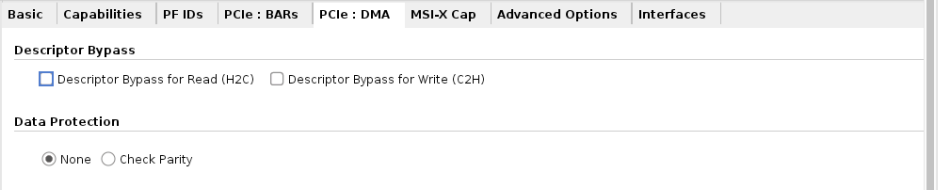
This functionality is not used by AMR.
MSI-X Cap
MSI-X capabilities for PF1 were enabled to be used in conjunction with the DMA.

Advanced Options
AMR uses vendor specific extended capabilities (VSEC) with the large extended configuration space. The extended capabilities contain the entries for the AXI remapping (AMR - Base Logic). To minimize design complexity, AMR does not enable virtualization capabilities, so ARI and ACS are disabled.
CPM5 TCL Configuration
The above configuration can be enabled using the TCL configuration settings below.
CONFIG.CPM_CONFIG { \
CPM_PCIE0_MODES {None} \
CPM_PCIE1_ACS_CAP_ON {0} \
CPM_PCIE1_ARI_CAP_ENABLED {0} \
CPM_PCIE1_CFG_EXT_IF {0} \
CPM_PCIE1_CFG_VEND_ID {10ee} \
CPM_PCIE1_COPY_PF0_QDMA_ENABLED {0} \
CPM_PCIE1_EXT_PCIE_CFG_SPACE_ENABLED {None} \
CPM_PCIE1_FUNCTIONAL_MODE {QDMA} \
CPM_PCIE1_MAX_LINK_SPEED {32.0_GT/s} \
CPM_PCIE1_MODES {DMA} \
CPM_PCIE1_MODE_SELECTION {Advanced} \
CPM_PCIE1_MSI_X_OPTIONS {MSI-X_Internal} \
CPM_PCIE1_PF0_AXIBAR2PCIE_BASEADDR_0 {0x0000008000000000} \
CPM_PCIE1_PF0_AXIBAR2PCIE_BASEADDR_1 {0x0000008040000000} \
CPM_PCIE1_PF0_AXIBAR2PCIE_BASEADDR_2 {0x0000008080000000} \
CPM_PCIE1_PF0_AXIBAR2PCIE_BASEADDR_3 {0x00000080C0000000} \
CPM_PCIE1_PF0_AXIBAR2PCIE_BASEADDR_4 {0x0000008100000000} \
CPM_PCIE1_PF0_AXIBAR2PCIE_BASEADDR_5 {0x0000008140000000} \
CPM_PCIE1_PF0_AXIBAR2PCIE_HIGHADDR_0 {0x000000803FFFFFFFF} \
CPM_PCIE1_PF0_AXIBAR2PCIE_HIGHADDR_1 {0x000000807FFFFFFFF} \
CPM_PCIE1_PF0_AXIBAR2PCIE_HIGHADDR_2 {0x00000080BFFFFFFFF} \
CPM_PCIE1_PF0_AXIBAR2PCIE_HIGHADDR_3 {0x00000080FFFFFFFFF} \
CPM_PCIE1_PF0_AXIBAR2PCIE_HIGHADDR_4 {0x000000813FFFFFFFF} \
CPM_PCIE1_PF0_AXIBAR2PCIE_HIGHADDR_5 {0x000000817FFFFFFFF} \
CPM_PCIE1_PF0_BAR0_QDMA_64BIT {1} \
CPM_PCIE1_PF0_BAR0_QDMA_ENABLED {1} \
CPM_PCIE1_PF0_BAR0_QDMA_PREFETCHABLE {0} \
CPM_PCIE1_PF0_BAR0_QDMA_SCALE {Megabytes} \
CPM_PCIE1_PF0_BAR0_QDMA_SIZE {8} \
CPM_PCIE1_PF0_BAR0_QDMA_TYPE {AXI_Bridge_Master} \
CPM_PCIE1_PF0_BAR2_QDMA_64BIT {0} \
CPM_PCIE1_PF0_BAR2_QDMA_ENABLED {0} \
CPM_PCIE1_PF0_BAR2_QDMA_PREFETCHABLE {0} \
CPM_PCIE1_PF0_BAR2_QDMA_SCALE {Kilobytes} \
CPM_PCIE1_PF0_BAR2_QDMA_SIZE {4} \
CPM_PCIE1_PF0_BAR2_QDMA_TYPE {AXI_Bridge_Master} \
CPM_PCIE1_PF0_BASE_CLASS_VALUE {12} \
CPM_PCIE1_PF0_CFG_DEV_ID {50b4} \
CPM_PCIE1_PF0_CFG_SUBSYS_ID {000e} \
CPM_PCIE1_PF0_DEV_CAP_FUNCTION_LEVEL_RESET_CAPABLE {0} \
CPM_PCIE1_PF0_MSIX_CAP_TABLE_OFFSET {40} \
CPM_PCIE1_PF0_MSIX_CAP_TABLE_SIZE {1} \
CPM_PCIE1_PF0_MSIX_ENABLED {0} \
CPM_PCIE1_PF0_PCIEBAR2AXIBAR_QDMA_0 {0x0000020100000000} \
CPM_PCIE1_PF0_SUB_CLASS_VALUE {00} \
CPM_PCIE1_PF1_BAR0_QDMA_64BIT {1} \
CPM_PCIE1_PF1_BAR0_QDMA_ENABLED {1} \
CPM_PCIE1_PF1_BAR0_QDMA_PREFETCHABLE {1} \
CPM_PCIE1_PF1_BAR0_QDMA_SCALE {Kilobytes} \
CPM_PCIE1_PF1_BAR0_QDMA_SIZE {512} \
CPM_PCIE1_PF1_BAR0_QDMA_STEERING {CPM_PCIE_NOC_1} \
CPM_PCIE1_PF1_BAR0_QDMA_TYPE {DMA} \
CPM_PCIE1_PF1_BAR2_QDMA_64BIT {1} \
CPM_PCIE1_PF1_BAR2_QDMA_ENABLED {1} \
CPM_PCIE1_PF1_BAR2_QDMA_PREFETCHABLE {1} \
CPM_PCIE1_PF1_BAR2_QDMA_SCALE {Megabytes} \
CPM_PCIE1_PF1_BAR2_QDMA_SIZE {256} \
CPM_PCIE1_PF1_BAR2_QDMA_STEERING {CPM_PCIE_NOC_1} \
CPM_PCIE1_PF1_BAR2_QDMA_TYPE {AXI_Bridge_Master} \
CPM_PCIE1_PF1_BASE_CLASS_VALUE {12} \
CPM_PCIE1_PF1_CFG_DEV_ID {50b5} \
CPM_PCIE1_PF1_CFG_SUBSYS_ID {000e} \
CPM_PCIE1_PF1_CFG_SUBSYS_VEND_ID {10EE} \
CPM_PCIE1_PF1_MSIX_CAP_TABLE_OFFSET {50000} \
CPM_PCIE1_PF1_MSIX_CAP_TABLE_SIZE {8} \
CPM_PCIE1_PF1_MSIX_ENABLED {1} \
CPM_PCIE1_PF1_PCIEBAR2AXIBAR_QDMA_2 {0x0000020200000000} \
CPM_PCIE1_PF1_SUB_CLASS_VALUE {00} \
CPM_PCIE1_PL_LINK_CAP_MAX_LINK_WIDTH {X8} \
CPM_PCIE1_TL_PF_ENABLE_REG {2} \
} \
PS PMC
There are numerous processor subsystem (PS) and platform management controller (PMC) settings. These settings (indicated below) align to the AMR design requirements. A description of the CIPS configuration options can be found in https://docs.xilinx.com/r/en-US/pg352-cips. Information on the PS/PMC can be found here: https://docs.xilinx.com/r/en-US/am011-versal-acap-trm/Processing-System-Architecture.
Processing Subsystem (RPU and APU)
The PS includes two Arm® Cortex®-R5F RPU processors and two Arm Cortex-A72 APU processors. These provide programmers with real-time and application operating environments.
PS PMC GUI Configuration
There are numerous PS/PMC configuration settings. The settings below were made per the AMR design requirements.
Boot Mode
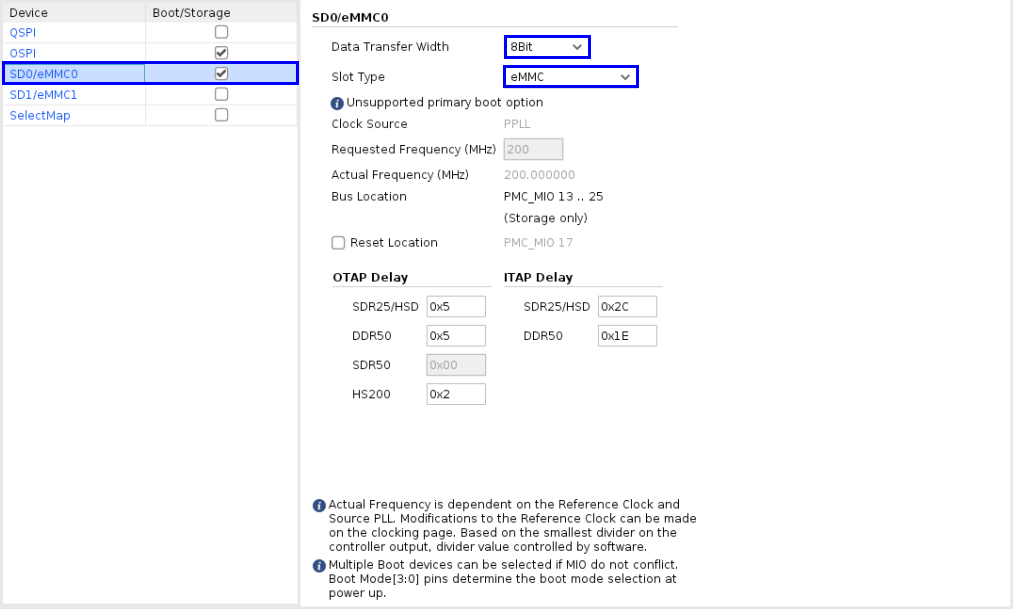
The Versal device is connected to 2Gb (256MB) OSPI for configuration and 64GB eMMC for storage. Both devices are 8-bits. These connections need to be enabled in PS PMC.
Note: eMMC1 cannot be used for boot since the pins are shared with OSPI.
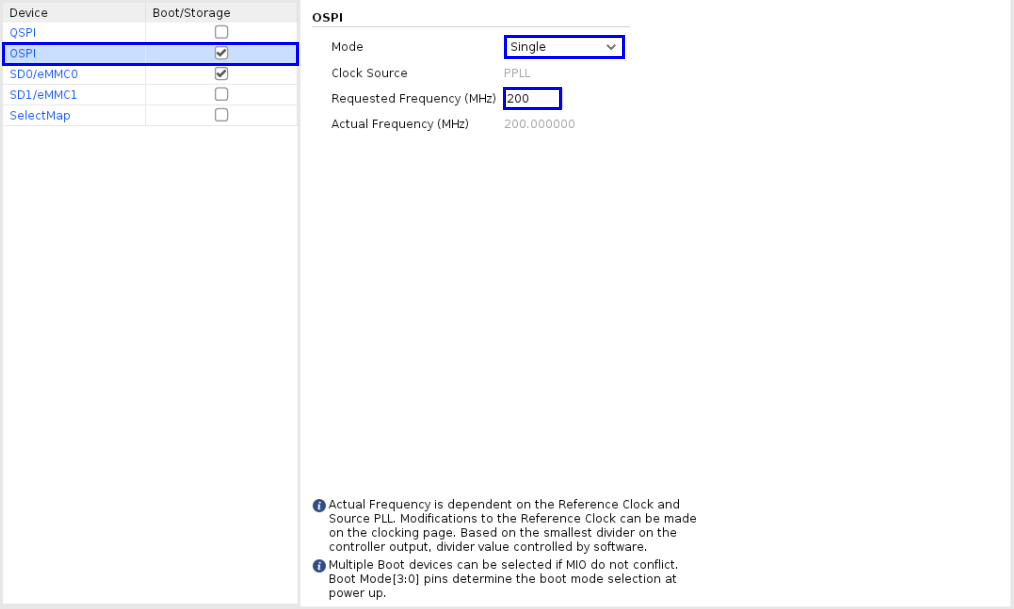
OSPI: Primary Boot
https://docs.xilinx.com/r/en-US/am011-versal-acap-trm/Primary-Boot-Interfaces-Table
Mode: Single device interface (not Stacked)
Frequency: A requested frequency of 200MHz was requested (Max frequency is 200MHz).
SDO/EMMC0: Used for storage or secondary boot
https://docs.xilinx.com/r/en-US/ug1304-versal-acap-ssdg/Secondary-Boot-Process-and-Device-Choices
Slot Type: eMMC
Data Transfer Width: 8Bit
Peripherals
Enable the peripherals as indicated below. These connections are dependent upon the Versal device connections to the board and are described below. The pin locations for the peripheral are not set in the ‘Peripheral’ tab. Instead, they are set in the ‘IO’ tab
PCIe Reset
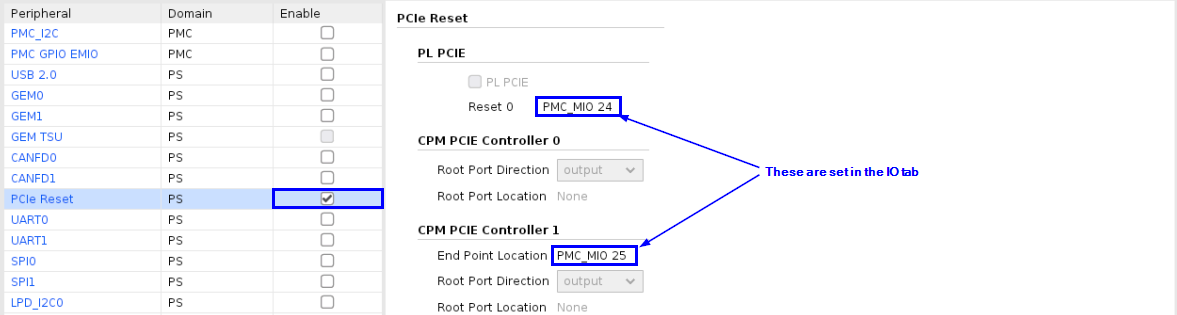
PCIe reset from the host is connected to the PMC MIO pins through a buffer. There is a reset for each PCIe controller to support bifurcation. Enable the PCIe reset, then to set the actual pin, switch to the IO tab.
IO → PS-Domain → PCIe Reset → CPM PCIE Controller 0 (End Point) → PMC_MIO_24
IO → PS-Domain → PCIe Reset → CPM PCIE Controller 1 (End Point) → PMC_MIO_25
https://docs.xilinx.com/r/en-US/am011-versal-acap-trm/PCIe-Resets-on-MIO-Pins
UART0 / UART1
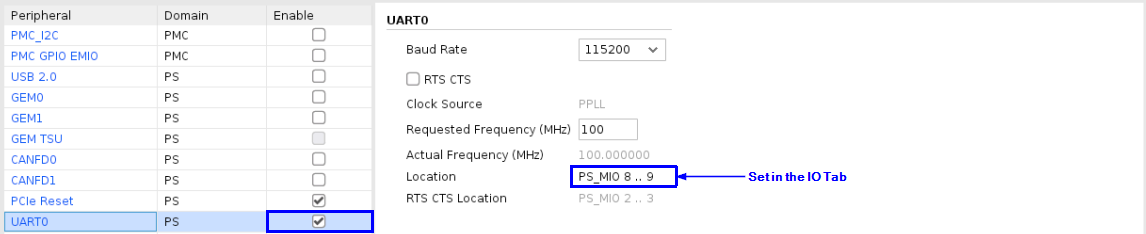
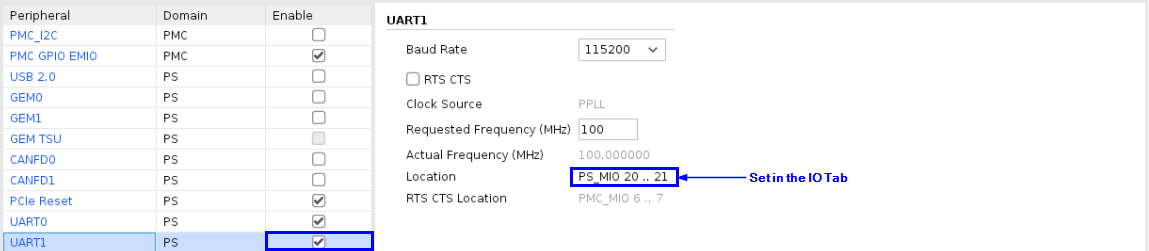
AMR connects to two UARTs on the PS MIO (LPD) for debug purposes.
IO → PS-Domain → UART0 → PS_MIO_8 and PS_MIO_9
IO → PS-Domain → UART1 → PS_MIO_20 and PS_MIO_21
https://docs.xilinx.com/r/en-US/am011-versal-acap-trm/UART-I/O-Signals
UART0
UART1
SPI0
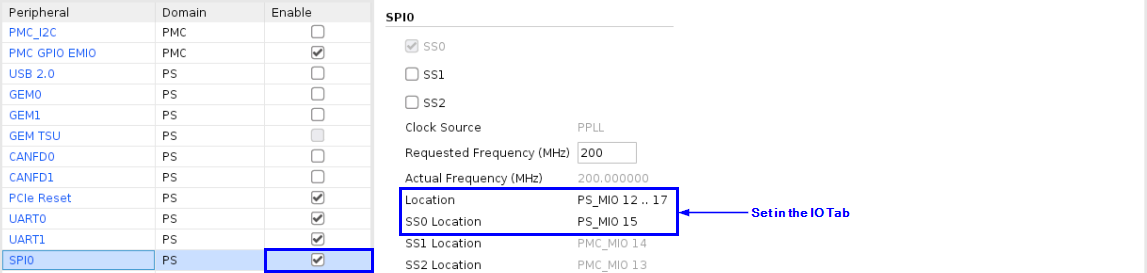
The Versal device connects to SPI0 in the PS MIO (LPD). This is used for logging flash.
IO → PS-Domain → SPI0 → PS_MIO_12 through PS_MIO_17
IO → PS-Domain → SPI0 → SS0 → PS_MIO_15
https://docs.xilinx.com/r/en-US/am011-versal-acap-trm/SPI-Controller-I/O-Signals
SPI0
LPD_I2C0 / LPD_I2C1
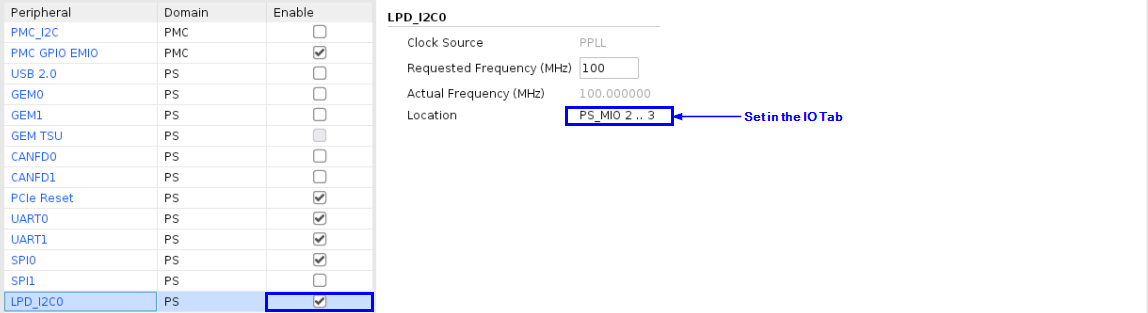
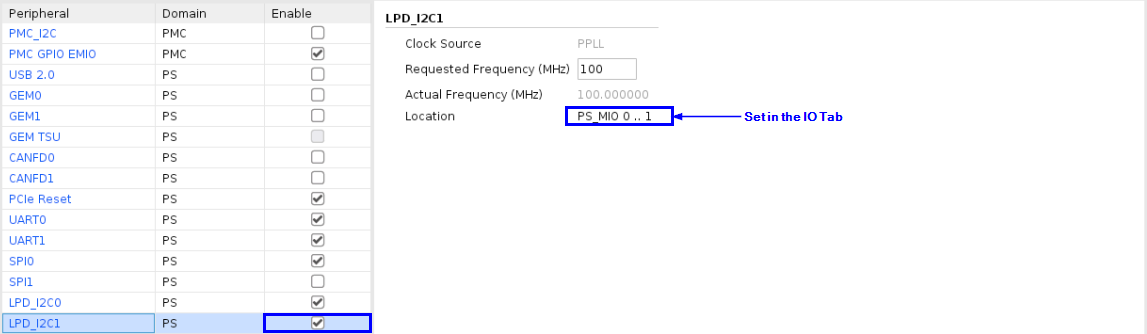
The Versal device connects to both I2C controllers in the LPD. I2C0 is the main I2C bus used for management of the board power, clocks, temperatures, etc. I2C1 is used for the management of the QSFPs (V80 only).
IO → PS-Domain → I2C0 → PS_MIO_2 and PS_MIO_3
IO → PS-Domain → I2C1 → PS_MIO_0 and PS_MIO_1
https://docs.xilinx.com/r/en-US/am011-versal-acap-trm/LPD-I2C-Interface-Signals
LPD_I2C0
LPD_I2C1
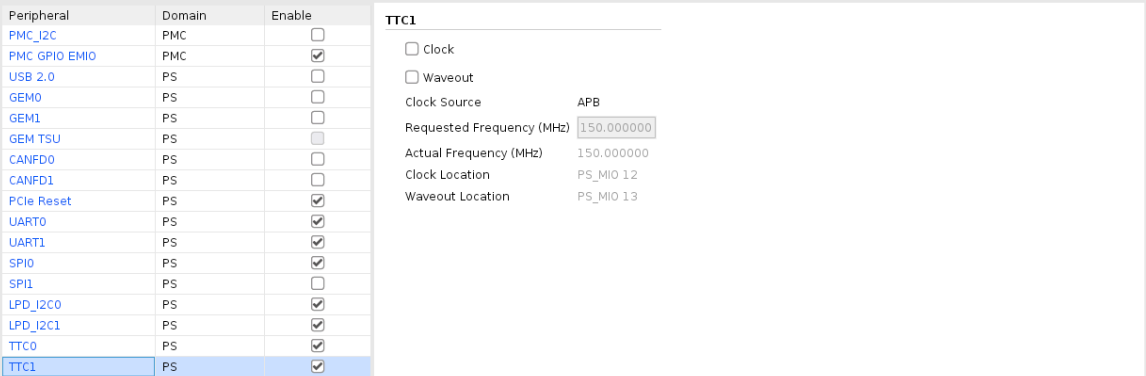
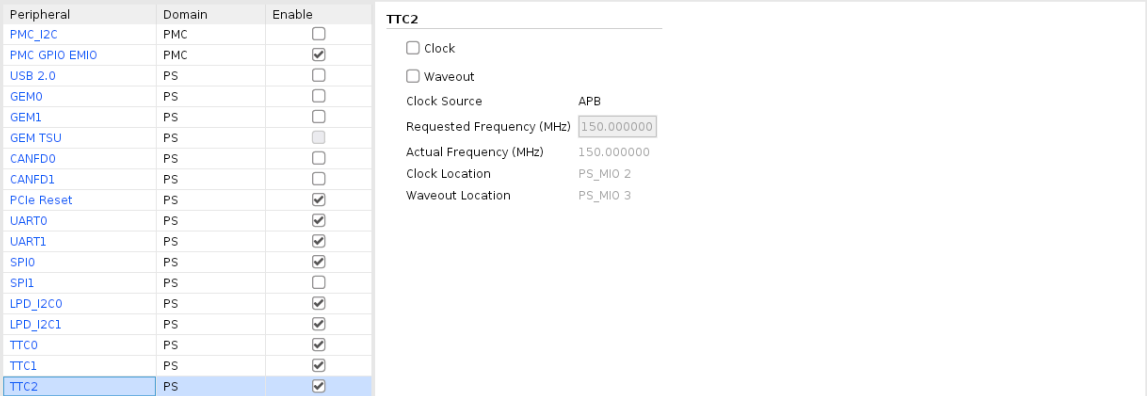
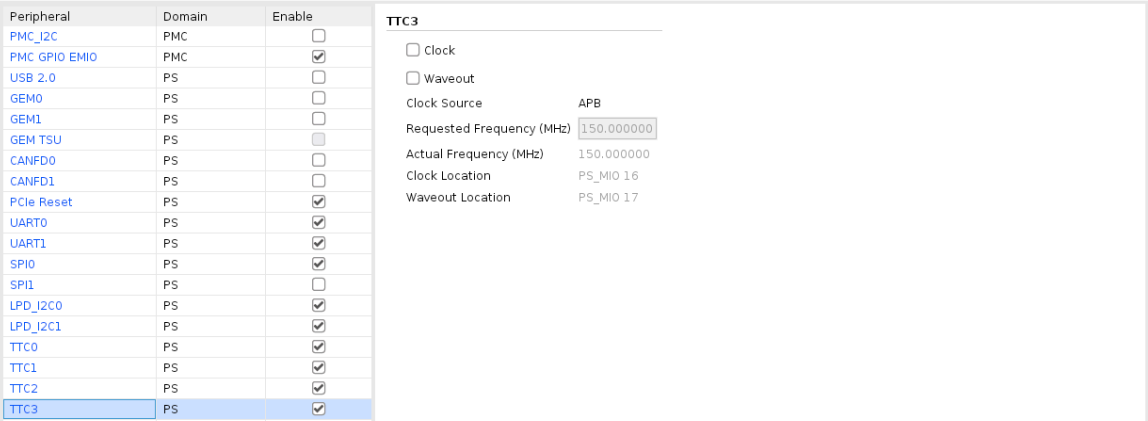
TTC0 / TTC1 / TTC2 / TTC3
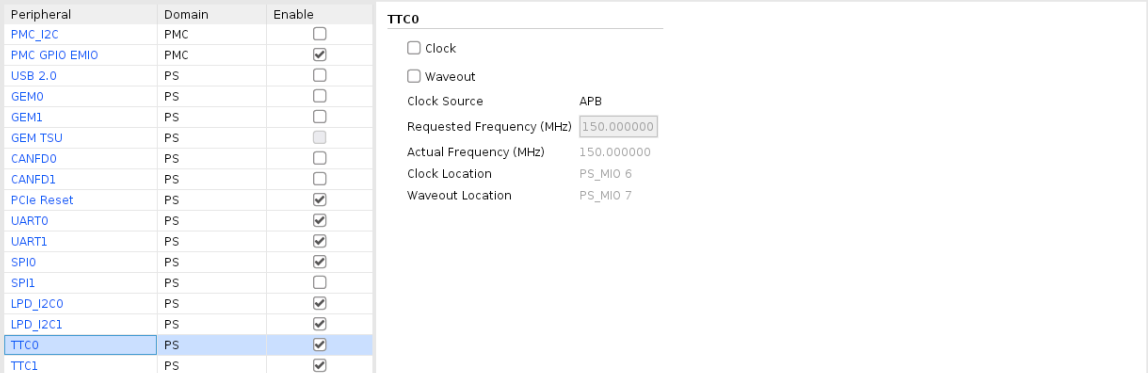
The triple timer counters (TTCs) can generate periodic interrupts or can be used to count the widths of signal pulses from an MIO pin or from the PL. In AMR, the TTCs are used by SW to generate periodic interrupts for runtime purposes. The TTCs cannot be used to monitor any HW functionality through the PMC MIO or PS MIO pins because there are not any spare MIO pins.
https://docs.xilinx.com/r/en-US/am011-versal-acap-trm/Triple-Timer-Counters
TTC0
TTC1
TTC2
TTC3
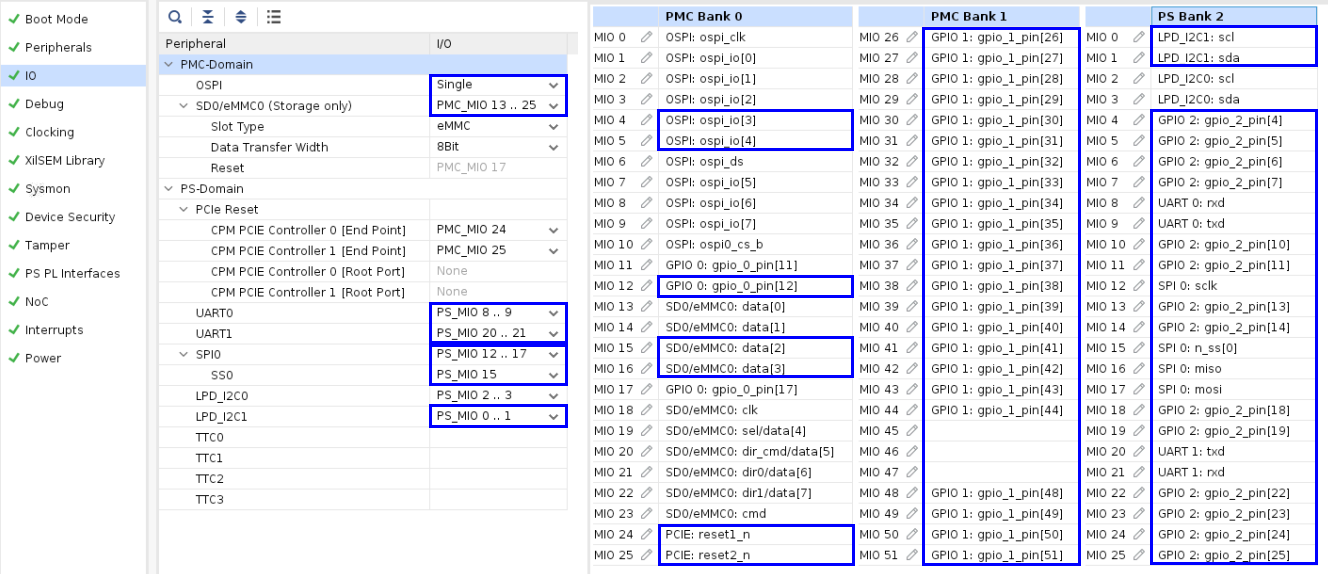
IO
PMC peripheral pins can have more than one MIO pin assignment option. More information on the different selections can be found here: https://docs.xilinx.com/r/en-US/am011-versal-acap-trm/PMC-MIO-Pin-Table. All the MIO pins (PMC, MIO, and PS MIO) are connected per the AMR design requirements. While PMC Bank 1 pins 45:47 appear to be unused in the capture below, there are signals connected to these pins for future growth.
When setting these pins in the GUI, first set the I/O pins in the Peripheral ‘I/O’ column. Be careful to select appropriately between PMC_MIO and PS_MIO. Then set the rest of the I/O in PMC Bank 0, PMC Bank 1, and PS Bank 2 columns.
The GPIO direction for each bank is set per the description below. They are also included as TCL in PS PMC TCL Settings.
PMC Bank 0: All the GPIO 0* signals are outputs except MIO_11, which is an input.
PMC Bank 1: All the GPIO 1* signals are outputs except MIO_33, MIO_37, MIO_41, MIO_48, MIO_49, MIO_50, which are inputs.
PS Bank 2: All the GPIO 2* signals are outputs except MIO_5, MIO_10, MIO_11, MIO_14, and MIO_25, which are inputs.
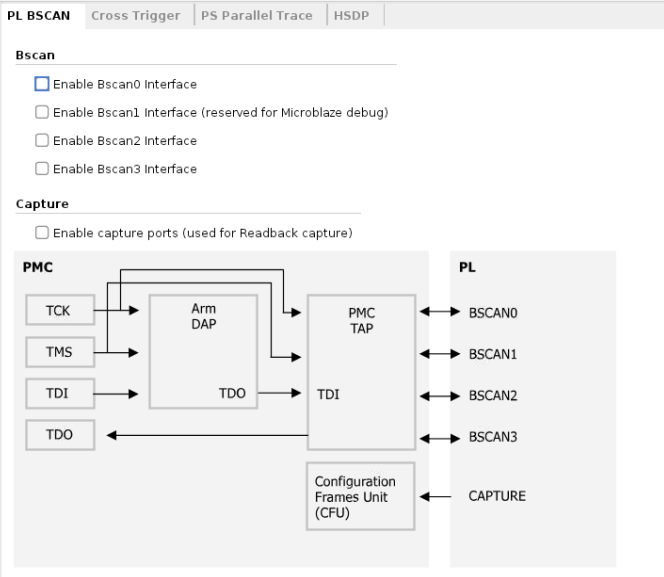
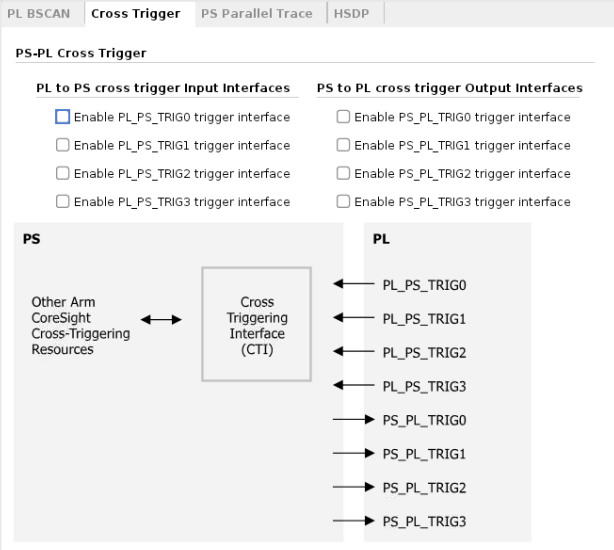
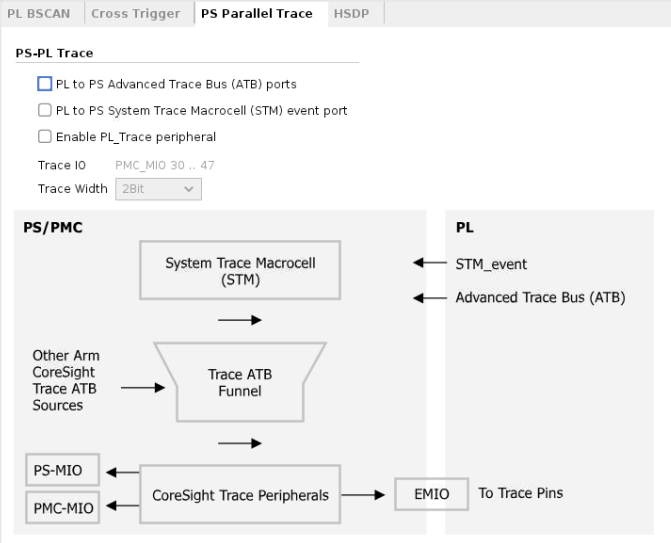
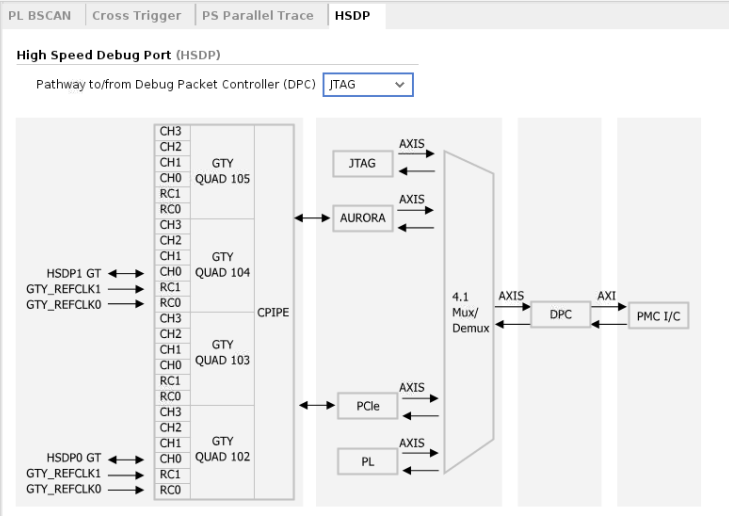
Clocking
Input Clocks
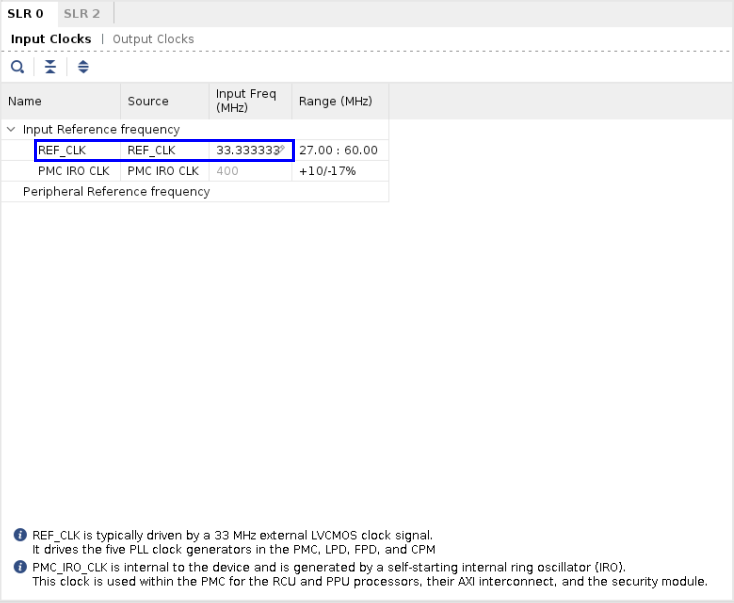
Change the input REF_CLK to match the board oscillator clock frequency (from 33.333MHz to 33.333333MHz).
REF_CLK: 33.333333
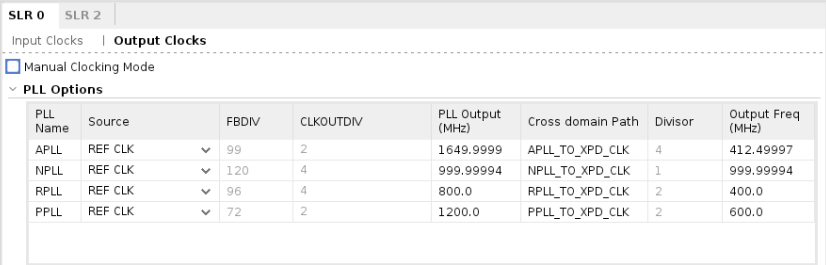
Output Clocks
SLR0
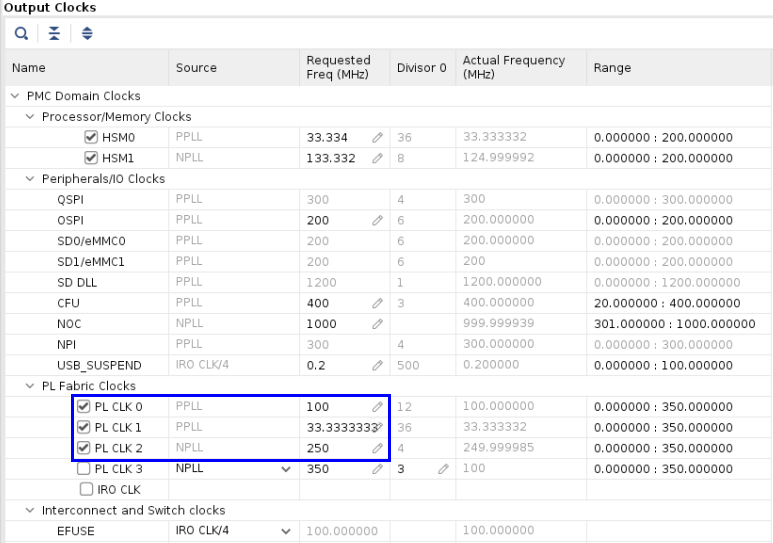
The Processor memory clocks (HSM0 and HSM1) are not used in AMR because it is a design requirement to use external 200MHz LVDS clocks for HBM and DDR MCs.
Enable the PL CLK 0, PL CLK 1, and PL CLK 2 and set the frequencies to 100MHz, 33.3333333MHz, and 250MHz (respectively). This creates the CIPs pl0_ref_clk, pl1_ref_clk, and pl2_ref_clk outputs from CIPS in the BD. PL CLK 0 (100MHz) is used for numerous AXI interfaces. PL CLK 1 is a free running clock used to generate other system clocks. PL CLK 2 (250MHz) is connected to the CPM5 DMA interface clock (dma1_intrfc_clk).
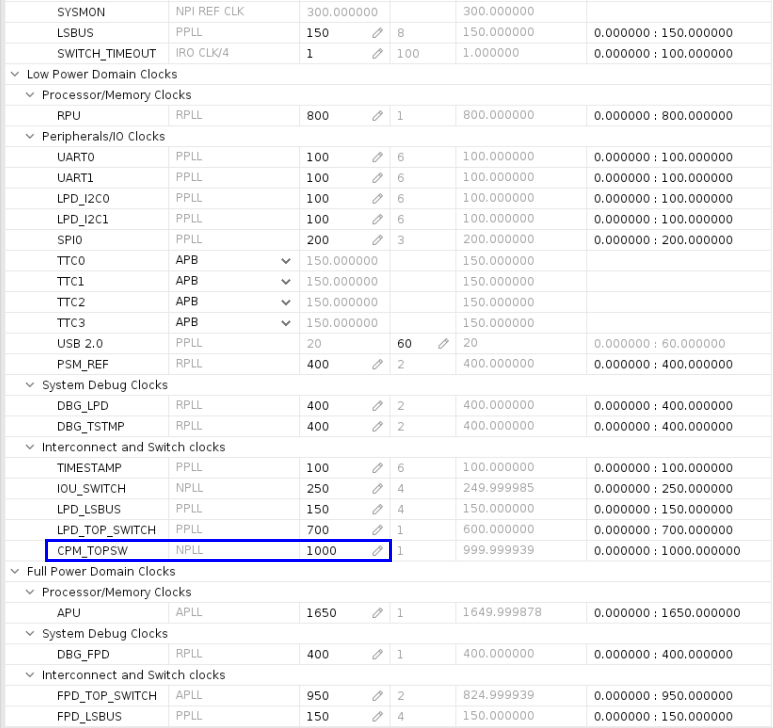
Change the CPM_TOPSW clock to 1000MHz so the CPM runs at maximum frequency.
SLR1
There are not any options for SLR1 - this tab does not exist.
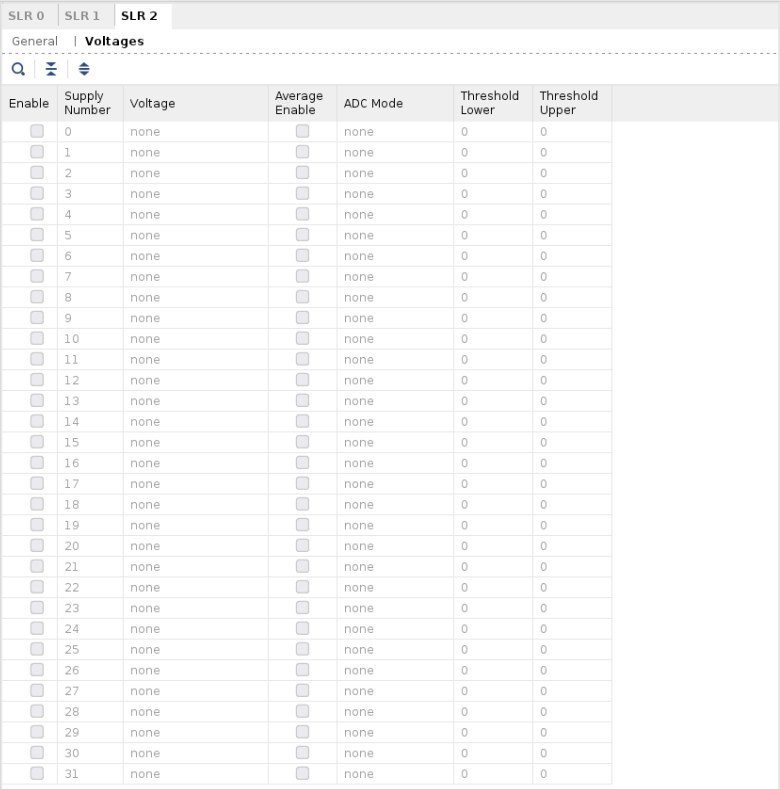
SLR2
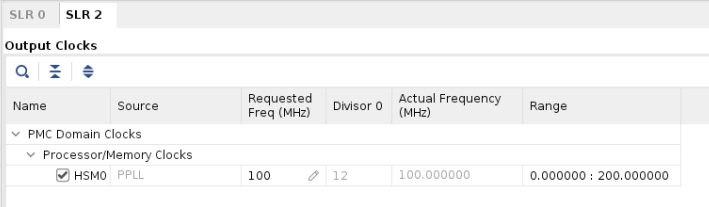
Leave at the default setting. The Processor memory clocks (HSM0 and HSM1) are not used in AMR because it is a design requirement to use external 200MHz LVDS clocks for HBM and DDR MCs.
XilSEM Library
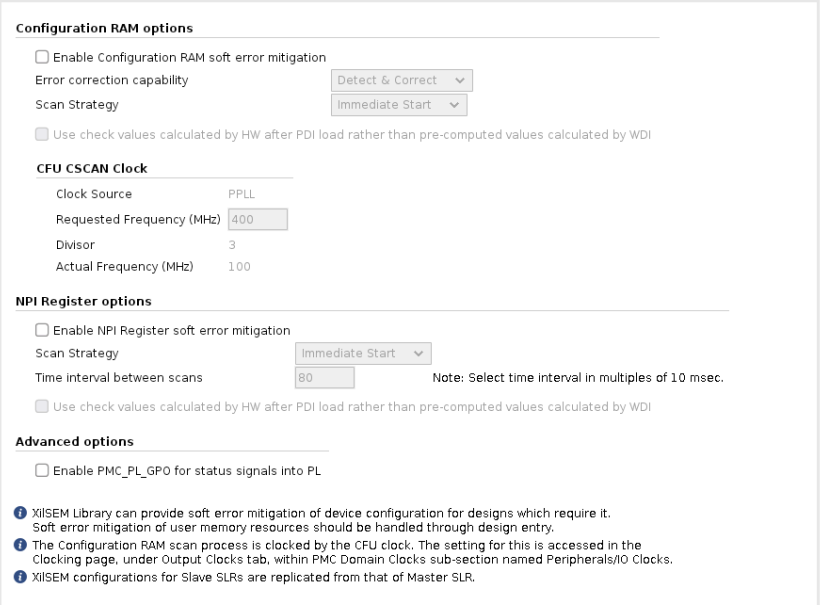
Leave all settings at Default. XilSEM is not used in AMR.
Sysmon
SLR0
Basic Configuration
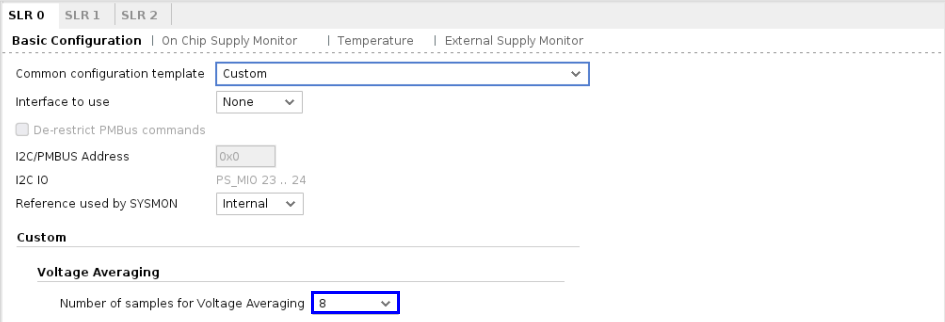
Change the voltage averaging samples to 8.
On Chip Supply
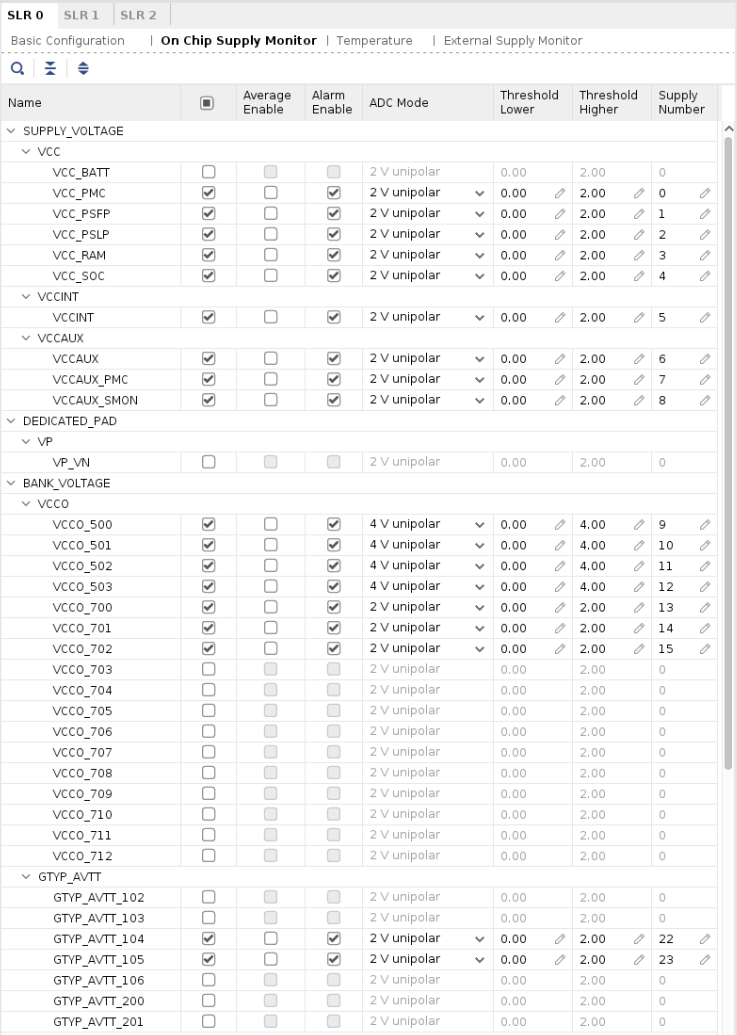
These are optional voltages that can be monitored by AMC for future use. The ADC and thresholds would need to be adjusted appropriately.
Additional information on the nomenclature can be found here: https://docs.xilinx.com/r/en-US/am011-versal-acap-trm/Power-Pins
VCC_PMC: PMC power domain
VCC_PSFP: PS full-power domain (FPD)
VCC_PSLP: PS low-power domain (LPD)
VCC_RAM: Block RAM, UltraRAM, and PL clocking network
VCCSOC: NoC, NPI, and DDRMC SoC power domain (SPD)
VCCINT: Internal logic (programmable logic, integrated hardware
VCCAUX: Auxiliary circuits
VCC_AUXPMC: Auxiliary for the PMC
VCCAUX_SMON: Analog for the ADC and other analog circuits in the system monitor
Monitor Configuration, PMC MIO, and PS MIO Banks
VCCO_500: PMC MIO bank 0 with dedicated analog signals DIO_A
VCCO_501: PMC MIO bank 1
VCCO_502: LPD MIO bank PS (PS_MIO)
VCCO_503: PMC dedicated I/O (DIO) bank - Config Bank Mode Pins and JTAG
Monitor DDR Banks Voltage
VCCO_700: CH0 DDR
VCCO_701: CH0 DDR
VCCO_702: CH0 DDR
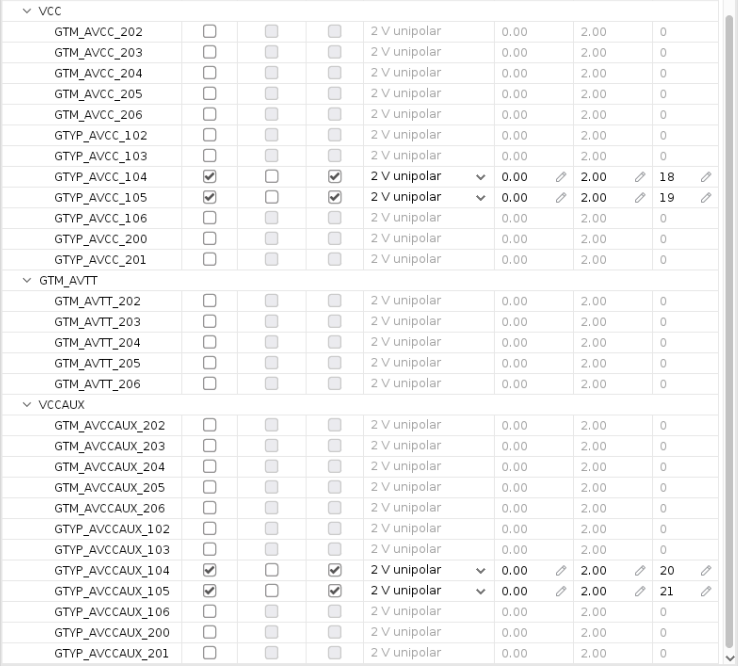
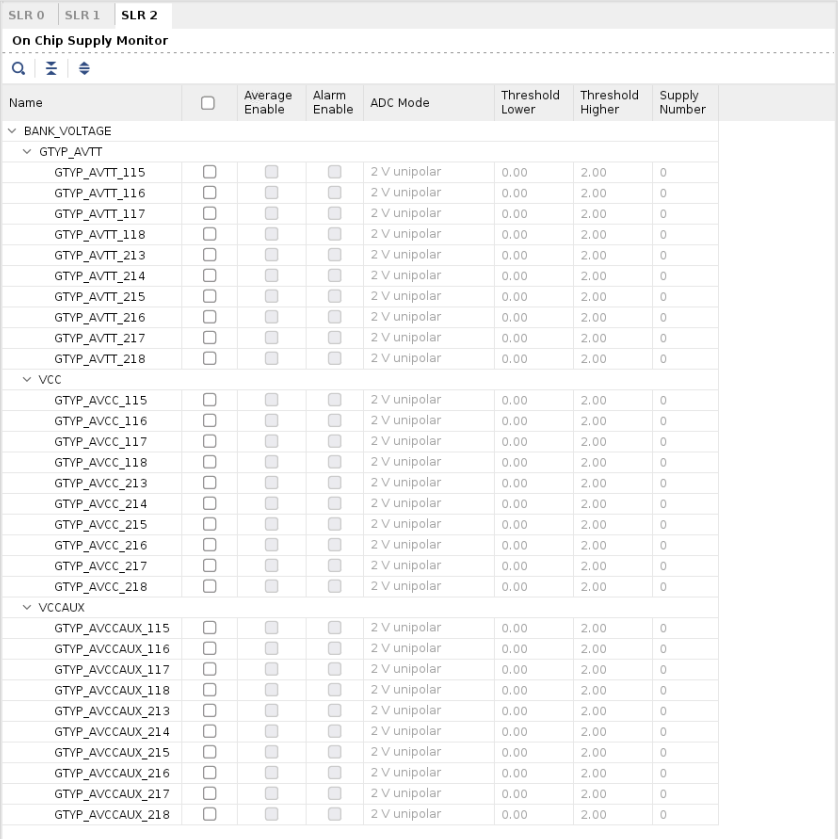
Monitor GTYP Bank Voltages
GTYP_AVTT_104: Gigabit transceiver; analog transmit driver
GTYP_AVTT_105: Gigabit transceiver; analog transmit driver
GTYP_AVCC_104: Gigabit transceiver; analog internal circuits
GTYP_AVCC_105: Gigabit transceiver; analog internal circuits
GTYP_AVCCAUX_104: Gigabit transceiver; auxiliary analog transceivers
GTYP_AVCCAUX_105: Gigabit transceiver; auxiliary analog transceivers
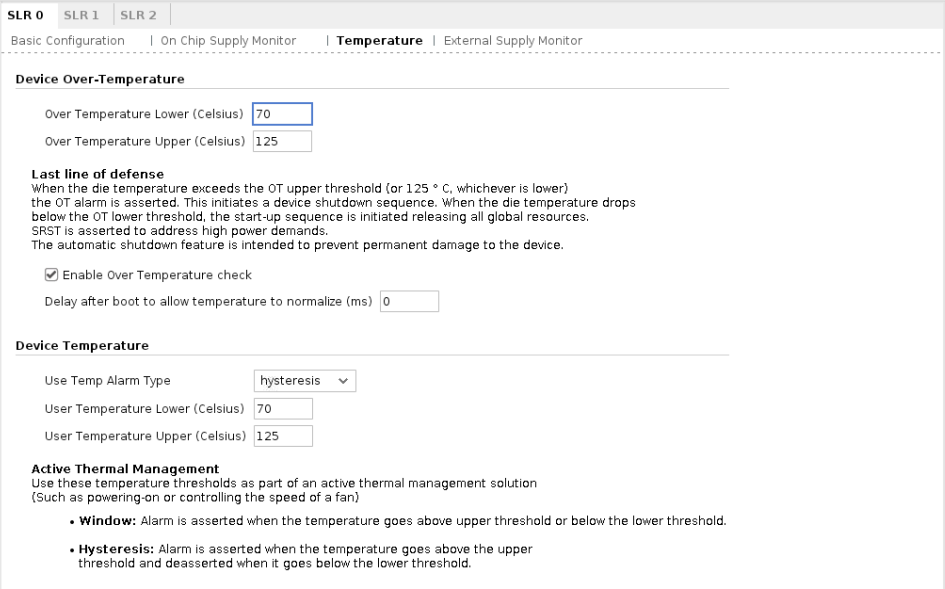
Temperature
Enable the over temperature check to help protect the Versal device and PCB.
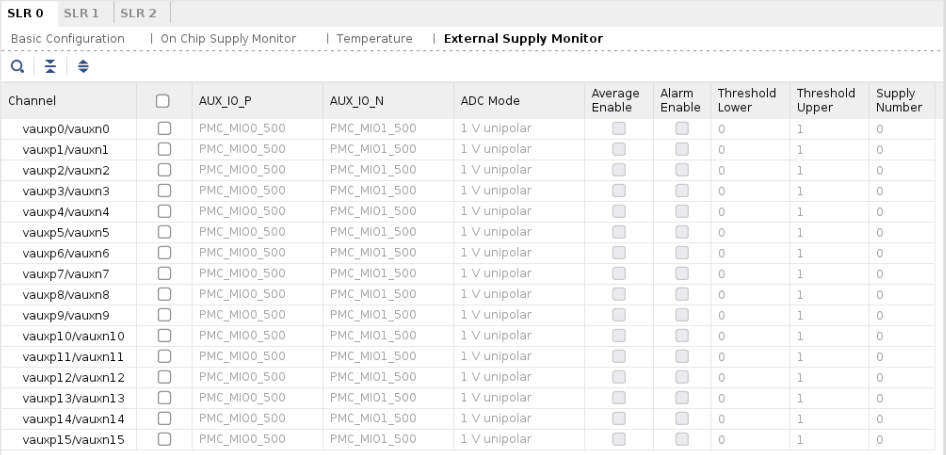
External Supply Monitor
None of the external supplies are monitored in AMR.
Device Security
SLR0
General
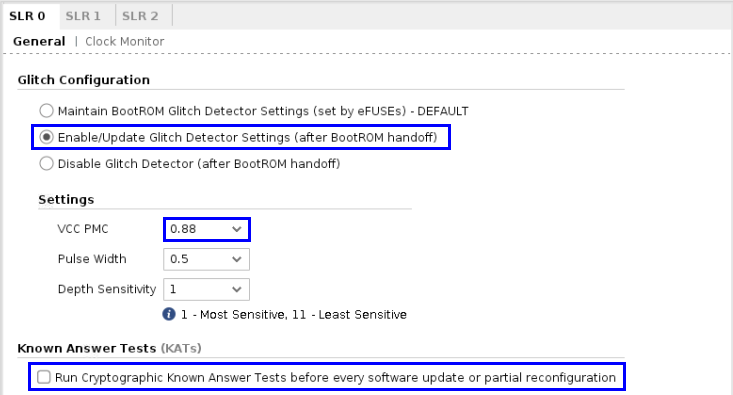
Select ‘Enable/Update Glitch Detector Settings (after BootROM handoff)’. This allows VCC_PMC to be changed to match the voltage setting of the AMR design requirements (0.88V).
The pulse width will ignore glitches less than the setting of 0.5ns.
Note: AMR does not enable a specific glitch detection response. If a response were required, it would need to be set up in the Tamper tab. AMR does not set any Tamper settings.
Unselect “Known Answer Tests (KATs)”. AMR does not use the Cryptographic engines, so there is no need to perform this test.
https://docs.xilinx.com/r/en-US/ug1304-versal-acap-ssdg/Known-Answer-Tests
Clock Monitor
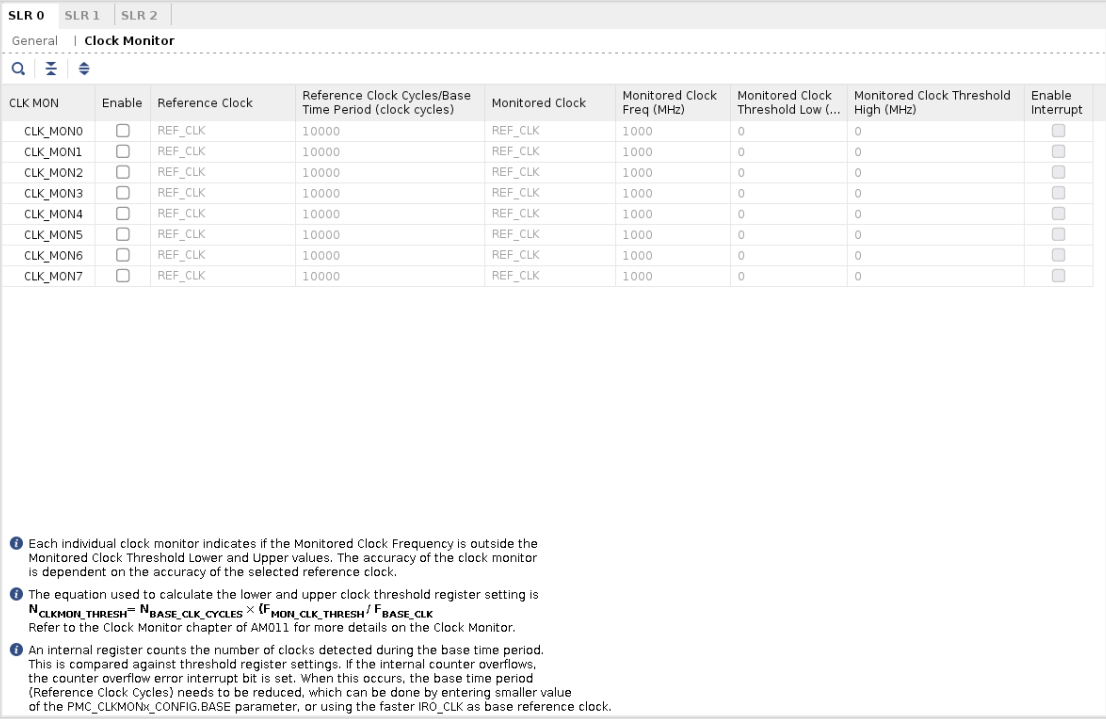
AMR does not enable clock monitoring. Leave all settings at Default.
SLR1
General
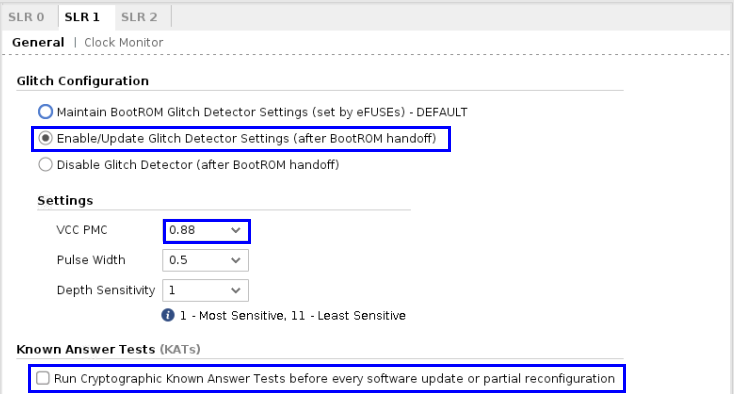
Select ‘Enable/Update Glitch Detector Settings (after BootROM handoff)’. This allows VCC_PMC to be changed to match the voltage setting of the AMR design requirements (0.88V).
The pulse width will ignore glitches less than the setting of 0.5ns.
Note: AMR does not enable a specific glitch detection response. If a response were required, it would need to be set up in the Tamper tab. AMR does not set any Tamper settings.
Unselect ‘Known Answer Tests (KATs)’. AMR does not use the Cryptographic engines, so there is no need to perform this test.
https://docs.xilinx.com/r/en-US/ug1304-versal-acap-ssdg/Known-Answer-Tests
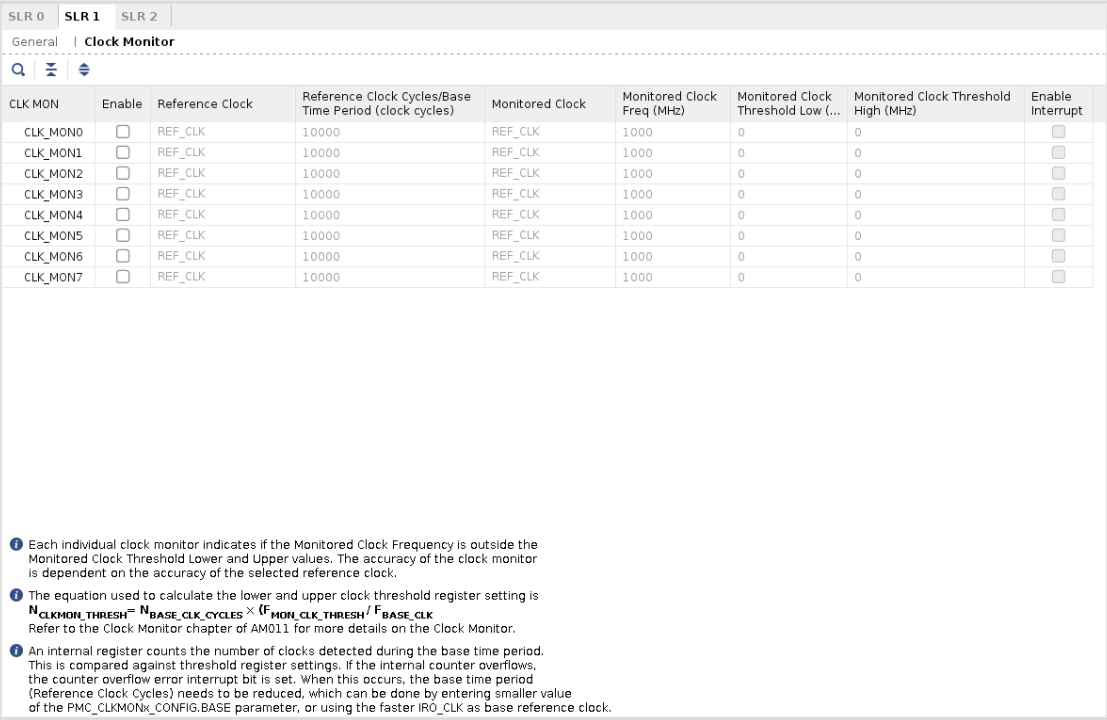
Clock Monitor
AMR does not enable clock monitoring. Leave all settings at default.
SLR2
General
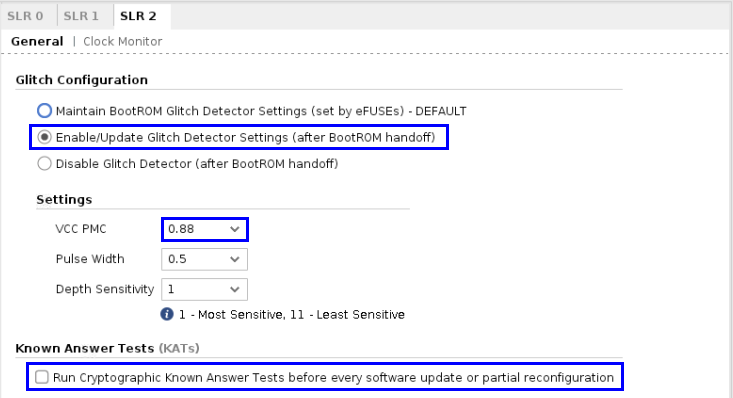
Select ‘Enable/Update Glitch Detector Settings (after BootROM handoff)’. This allows VCC_PMC to be changed to match the voltage setting of the AMR design requirements (0.88V).
The Pulse Width will ignore glitches less than the setting of 0.5ns.
Note: AMR does not enable a specific glitch detection response. If a response were required, it would need to be set up in the Tamper tab. AMR does not set any Tamper settings.
Unselect ‘Known Answer Tests (KATs)’. AMR does not use the cryptographic engines, so there is no need to perform this test.
https://docs.xilinx.com/r/en-US/ug1304-versal-acap-ssdg/Known-Answer-Tests
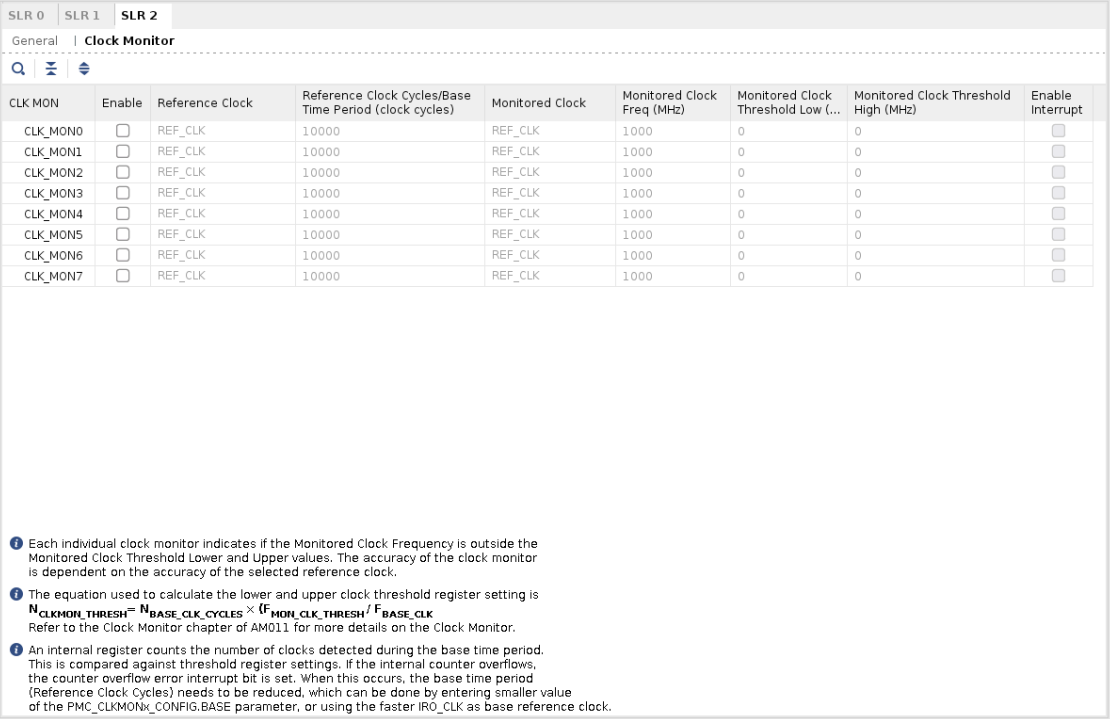
Clock Monitor
AMR does not enable clock monitoring. Leave all settings at default.
Tamper
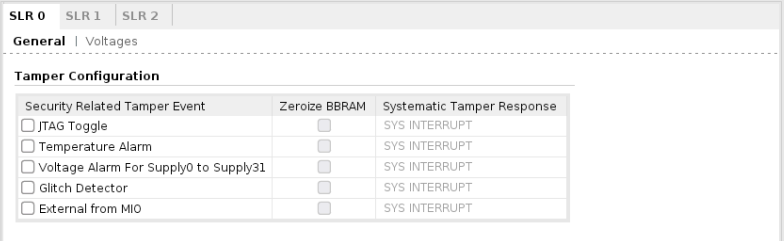
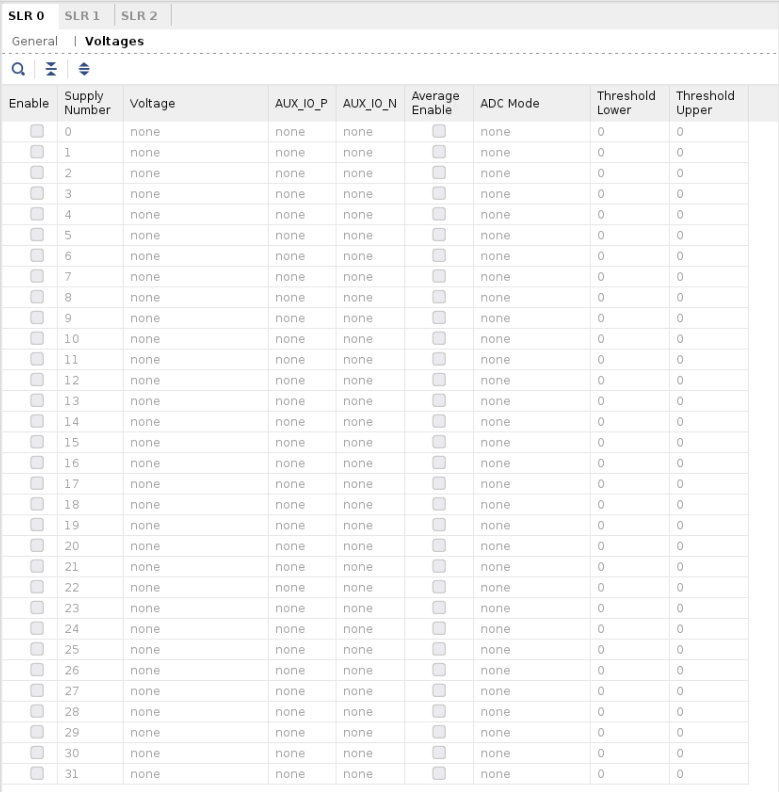
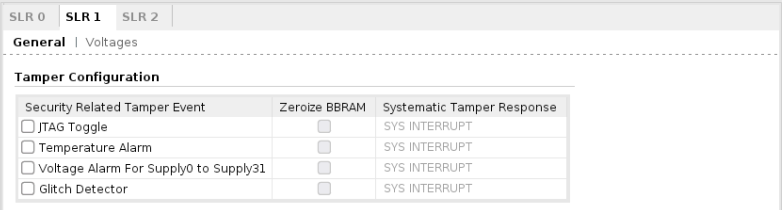
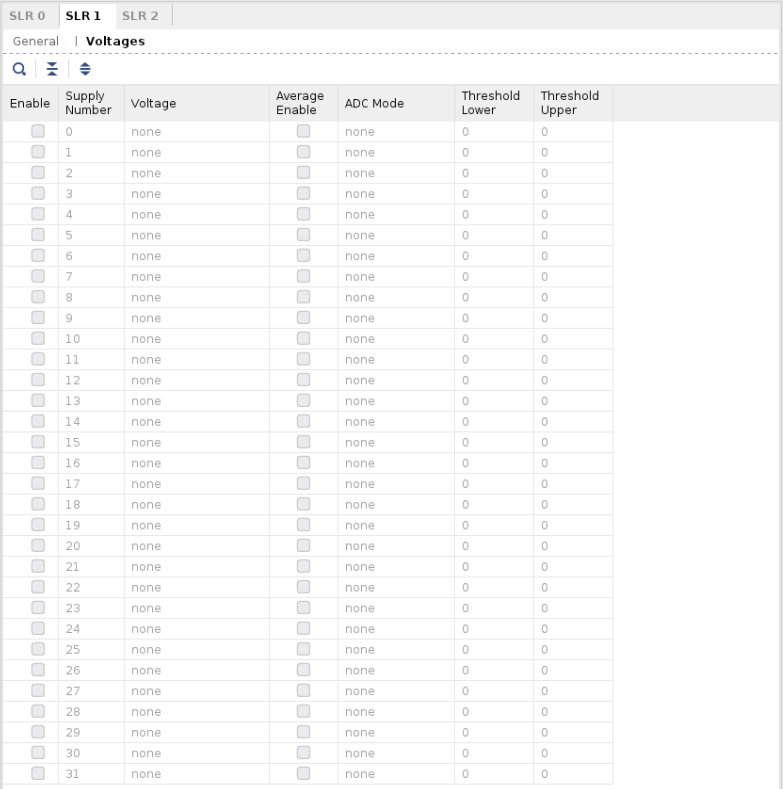
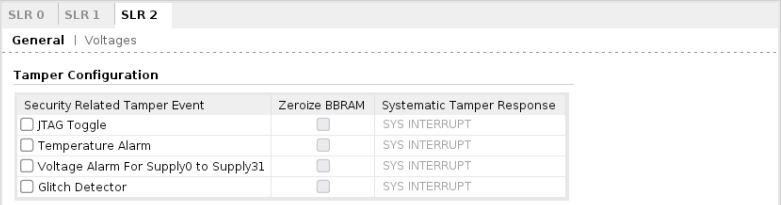
AMR does not exercise Tamper functionality. It could be used to set a systematic response to a tamper event.
https://docs.xilinx.com/r/en-US/ug1304-versal-acap-ssdg/Secure-Lockdown-Support-in-PLM
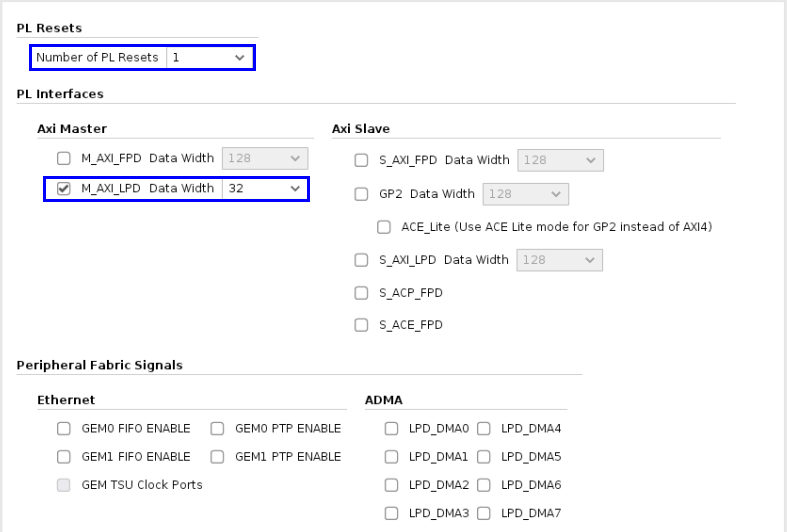
PS PL Interfaces
AMR only uses one PL reset from CIPS and it is enabled here. This reset is used to create multiple derived resets synchronized to various PL clock domains.
Current Base Design:
‘Number of PL Resets: 1’ creates the CIPS pl0_resetn output
M_AXI_LPD is enabled (32-bit @ 100MHz) and connected to the SMBus hierarchical block (
smbus_hier/S00_AXI)The SMBus IP is clocked by pl0_ref_clk (100 MHz) and its interrupt (
ip2intc_irpt) is wired tocips/pl_ps_irq1
Note: The General Command Queue (GCQ) is implemented as a software abstraction in firmware using shared DDR memory, not as a hardware IP block in the current V80 base design.
NoC
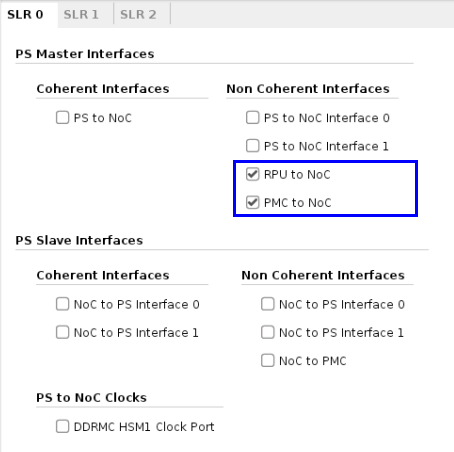
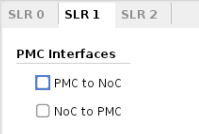
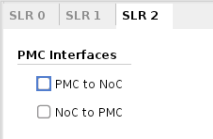
AMR uses two PS NoC connections on SLR0 for PMC and RPU communication to other NoCs. A description of the available options are here: https://docs.xilinx.com/r/en-US/pg352-cips/PS-NoC-Interfaces.
SLR0
RPU:
Select ‘RPU to NoC’: This creates the 128-bit @ 800MHz LPD_AXI_NOC_0 port on CIPS
PMC:
Select ‘PMC to NoC’: This creates the 128-bit @ 400MHz PMC_NOC_AXI_0 port on CIPS
Interrupts
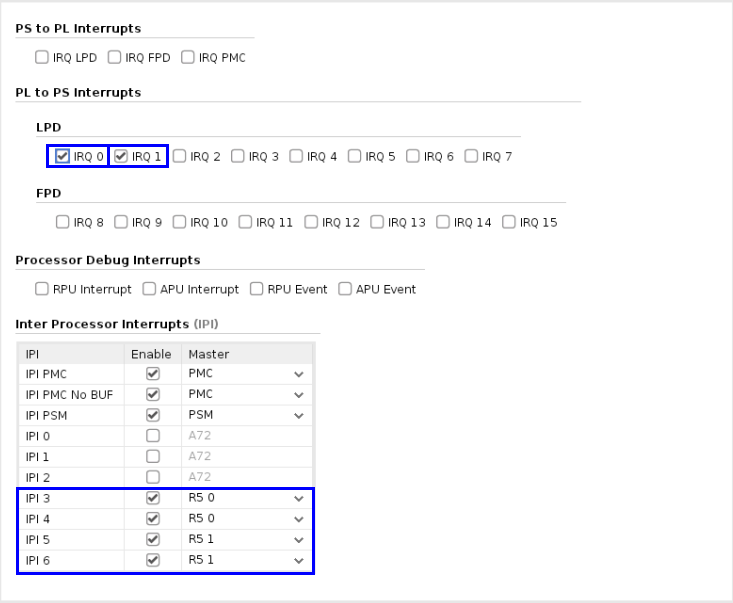
Interrupt Configuration:
The base design uses two LPD interrupt channels (PS_IRQ_USAGE CH0 and CH1 enabled):
pl_ps_irq1: Connected to SMBus IP interrupt (
smbus_hier/ip2intc_irpt)pl_ps_irq0: Available for future use (e.g., firmware GCQ signaling)
Enable Inter Processor Interrupts. The Inter Processor Interrupts allows one processor to interrupt another processor. The PMC and PSM Interrupts are enabled by default, and use the first three IPI agents. To allow R5 interrupts to the PMC and PSM, AMR uses four additional agents; IPI3, IPI4, IPI5, and IPI6. Two agents are used for each R5 processor. These can be changed as deemed necessary.
IPI 0:2: N/C
IPI 3:4: R5 0
IPI 5:6: R5 1
Power
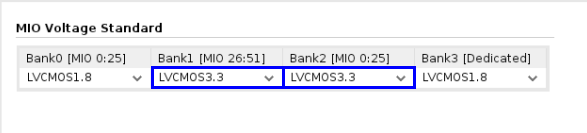
Set the AMR MIO Bank voltages to match the AMR design requirements.
Bank0 [MIO 0:25]: LVCMOS 1.8V (default)
Bank1 [MIO 26:51]: LVCMOS 3.3V
Bank2 [MIO 0:25]: LVCMOS 3.3V
Bank3 [Dedicated]: LVCMOS 1.8V (default)
PS PMC TCL Settings
CONFIG.PS_PMC_CONFIG { \
BOOT_MODE {Custom} \
CLOCK_MODE {Custom} \
DDR_MEMORY_MODE {Custom} \
DESIGN_MODE {1} \
DEVICE_INTEGRITY_MODE {Custom} \
IO_CONFIG_MODE {Custom} \
PCIE_APERTURES_DUAL_ENABLE {0} \
PCIE_APERTURES_SINGLE_ENABLE {1} \
PMC_BANK_1_IO_STANDARD {LVCMOS3.3} \
PMC_CRP_OSPI_REF_CTRL_FREQMHZ {200} \
PMC_CRP_PL0_REF_CTRL_FREQMHZ {100} \
PMC_CRP_PL1_REF_CTRL_FREQMHZ {33.3333333} \
PMC_CRP_PL2_REF_CTRL_FREQMHZ {250} \
PMC_GLITCH_CONFIG {{DEPTH_SENSITIVITY 1} {MIN_PULSE_WIDTH 0.5} {TYPE CUSTOM} {VCC_PMC_VALUE 0.88}} \
PMC_GLITCH_CONFIG_1 {{DEPTH_SENSITIVITY 1} {MIN_PULSE_WIDTH 0.5} {TYPE CUSTOM} {VCC_PMC_VALUE 0.88}} \
PMC_GLITCH_CONFIG_2 {{DEPTH_SENSITIVITY 1} {MIN_PULSE_WIDTH 0.5} {TYPE CUSTOM} {VCC_PMC_VALUE 0.88}} \
PMC_GPIO_EMIO_PERIPHERAL_ENABLE {0} \
PMC_MIO11 {{AUX_IO 0} {DIRECTION in} {DRIVE_STRENGTH 8mA} {OUTPUT_DATA default} {PULL pullup} {SCHMITT 0} {SLEW slow} {USAGE GPIO}} \
PMC_MIO12 {{AUX_IO 0} {DIRECTION out} {DRIVE_STRENGTH 8mA} {OUTPUT_DATA default} {PULL pullup} {SCHMITT 0} {SLEW slow} {USAGE GPIO}} \
PMC_MIO13 {{AUX_IO 0} {DIRECTION inout} {DRIVE_STRENGTH 8mA} {OUTPUT_DATA default} {PULL pullup} {SCHMITT 0} {SLEW slow} {USAGE Reserved}} \
PMC_MIO17 {{AUX_IO 0} {DIRECTION out} {DRIVE_STRENGTH 8mA} {OUTPUT_DATA default} {PULL pullup} {SCHMITT 0} {SLEW slow} {USAGE GPIO}} \
PMC_MIO26 {{AUX_IO 0} {DIRECTION out} {DRIVE_STRENGTH 8mA} {OUTPUT_DATA default} {PULL pullup} {SCHMITT 0} {SLEW slow} {USAGE GPIO}} \
PMC_MIO27 {{AUX_IO 0} {DIRECTION out} {DRIVE_STRENGTH 8mA} {OUTPUT_DATA default} {PULL pullup} {SCHMITT 0} {SLEW slow} {USAGE GPIO}} \
PMC_MIO28 {{AUX_IO 0} {DIRECTION out} {DRIVE_STRENGTH 8mA} {OUTPUT_DATA default} {PULL pullup} {SCHMITT 0} {SLEW slow} {USAGE GPIO}} \
PMC_MIO29 {{AUX_IO 0} {DIRECTION out} {DRIVE_STRENGTH 8mA} {OUTPUT_DATA default} {PULL pullup} {SCHMITT 0} {SLEW slow} {USAGE GPIO}} \
PMC_MIO30 {{AUX_IO 0} {DIRECTION out} {DRIVE_STRENGTH 8mA} {OUTPUT_DATA default} {PULL pullup} {SCHMITT 0} {SLEW slow} {USAGE GPIO}} \
PMC_MIO31 {{AUX_IO 0} {DIRECTION out} {DRIVE_STRENGTH 8mA} {OUTPUT_DATA default} {PULL pullup} {SCHMITT 0} {SLEW slow} {USAGE GPIO}} \
PMC_MIO32 {{AUX_IO 0} {DIRECTION out} {DRIVE_STRENGTH 8mA} {OUTPUT_DATA default} {PULL pullup} {SCHMITT 0} {SLEW slow} {USAGE GPIO}} \
PMC_MIO33 {{AUX_IO 0} {DIRECTION in} {DRIVE_STRENGTH 8mA} {OUTPUT_DATA default} {PULL pullup} {SCHMITT 0} {SLEW slow} {USAGE GPIO}} \
PMC_MIO34 {{AUX_IO 0} {DIRECTION out} {DRIVE_STRENGTH 8mA} {OUTPUT_DATA default} {PULL pullup} {SCHMITT 0} {SLEW slow} {USAGE GPIO}} \
PMC_MIO35 {{AUX_IO 0} {DIRECTION out} {DRIVE_STRENGTH 8mA} {OUTPUT_DATA default} {PULL pullup} {SCHMITT 0} {SLEW slow} {USAGE GPIO}} \
PMC_MIO36 {{AUX_IO 0} {DIRECTION out} {DRIVE_STRENGTH 8mA} {OUTPUT_DATA default} {PULL pullup} {SCHMITT 0} {SLEW slow} {USAGE GPIO}} \
PMC_MIO37 {{AUX_IO 0} {DIRECTION in} {DRIVE_STRENGTH 8mA} {OUTPUT_DATA default} {PULL pullup} {SCHMITT 0} {SLEW slow} {USAGE GPIO}} \
PMC_MIO38 {{AUX_IO 0} {DIRECTION out} {DRIVE_STRENGTH 8mA} {OUTPUT_DATA default} {PULL pullup} {SCHMITT 0} {SLEW slow} {USAGE GPIO}} \
PMC_MIO39 {{AUX_IO 0} {DIRECTION out} {DRIVE_STRENGTH 8mA} {OUTPUT_DATA default} {PULL pullup} {SCHMITT 0} {SLEW slow} {USAGE GPIO}} \
PMC_MIO40 {{AUX_IO 0} {DIRECTION out} {DRIVE_STRENGTH 8mA} {OUTPUT_DATA default} {PULL pullup} {SCHMITT 0} {SLEW slow} {USAGE GPIO}} \
PMC_MIO41 {{AUX_IO 0} {DIRECTION in} {DRIVE_STRENGTH 8mA} {OUTPUT_DATA default} {PULL pullup} {SCHMITT 0} {SLEW slow} {USAGE GPIO}} \
PMC_MIO42 {{AUX_IO 0} {DIRECTION out} {DRIVE_STRENGTH 8mA} {OUTPUT_DATA default} {PULL pullup} {SCHMITT 0} {SLEW slow} {USAGE GPIO}} \
PMC_MIO43 {{AUX_IO 0} {DIRECTION out} {DRIVE_STRENGTH 8mA} {OUTPUT_DATA default} {PULL pullup} {SCHMITT 0} {SLEW slow} {USAGE GPIO}} \
PMC_MIO44 {{AUX_IO 0} {DIRECTION out} {DRIVE_STRENGTH 8mA} {OUTPUT_DATA default} {PULL pullup} {SCHMITT 0} {SLEW slow} {USAGE GPIO}} \
PMC_MIO48 {{AUX_IO 0} {DIRECTION in} {DRIVE_STRENGTH 8mA} {OUTPUT_DATA default} {PULL pullup} {SCHMITT 0} {SLEW slow} {USAGE GPIO}} \
PMC_MIO49 {{AUX_IO 0} {DIRECTION in} {DRIVE_STRENGTH 8mA} {OUTPUT_DATA default} {PULL pullup} {SCHMITT 0} {SLEW slow} {USAGE GPIO}} \
PMC_MIO50 {{AUX_IO 0} {DIRECTION in} {DRIVE_STRENGTH 8mA} {OUTPUT_DATA default} {PULL pullup} {SCHMITT 0} {SLEW slow} {USAGE GPIO}} \
PMC_MIO51 {{AUX_IO 0} {DIRECTION out} {DRIVE_STRENGTH 8mA} {OUTPUT_DATA default} {PULL pullup} {SCHMITT 0} {SLEW slow} {USAGE GPIO}} \
PMC_MIO_EN_FOR_PL_PCIE {0} \
PMC_OSPI_PERIPHERAL {{ENABLE 1} {IO {PMC_MIO 0 .. 11}} {MODE Single}} \
PMC_REF_CLK_FREQMHZ {33.333333} \
PMC_SD0_DATA_TRANSFER_MODE {8Bit} \
PMC_SD0_PERIPHERAL {{CLK_100_SDR_OTAP_DLY 0x00} {CLK_200_SDR_OTAP_DLY 0x2} {CLK_50_DDR_ITAP_DLY 0x1E} {CLK_50_DDR_OTAP_DLY 0x5} {CLK_50_SDR_ITAP_DLY 0x2C} {CLK_50_SDR_OTAP_DLY 0x5} {ENABLE 1} {IO\
{PMC_MIO 13 .. 25}}} \
PMC_SD0_SLOT_TYPE {eMMC} \
PMC_USE_PMC_NOC_AXI0 {0} \
PS_BANK_2_IO_STANDARD {LVCMOS3.3} \
PS_BOARD_INTERFACE {Custom} \
PS_CRL_CPM_TOPSW_REF_CTRL_FREQMHZ {1000} \
PS_GEN_IPI0_ENABLE {0} \
PS_GEN_IPI1_ENABLE {0} \
PS_GEN_IPI2_ENABLE {0} \
PS_GEN_IPI3_ENABLE {1} \
PS_GEN_IPI3_MASTER {R5_0} \
PS_GEN_IPI4_ENABLE {1} \
PS_GEN_IPI4_MASTER {R5_0} \
PS_GEN_IPI5_ENABLE {1} \
PS_GEN_IPI5_MASTER {R5_1} \
PS_GEN_IPI6_ENABLE {1} \
PS_GEN_IPI6_MASTER {R5_1} \
PS_GPIO_EMIO_PERIPHERAL_ENABLE {0} \
PS_I2C0_PERIPHERAL {{ENABLE 1} {IO {PS_MIO 2 .. 3}}} \
PS_I2C1_PERIPHERAL {{ENABLE 1} {IO {PS_MIO 0 .. 1}}} \
PS_IRQ_USAGE {{CH0 1} {CH1 1} {CH10 0} {CH11 0} {CH12 0} {CH13 0} {CH14 0} {CH15 0} {CH2 0} {CH3 0} {CH4 0} {CH5 0} {CH6 0} {CH7 0} {CH8 0} {CH9 0}} \
PS_KAT_ENABLE {0} \
PS_KAT_ENABLE_1 {0} \
PS_KAT_ENABLE_2 {0} \
PS_MIO10 {{AUX_IO 0} {DIRECTION in} {DRIVE_STRENGTH 8mA} {OUTPUT_DATA default} {PULL pullup} {SCHMITT 0} {SLEW slow} {USAGE GPIO}} \
PS_MIO11 {{AUX_IO 0} {DIRECTION in} {DRIVE_STRENGTH 8mA} {OUTPUT_DATA default} {PULL pullup} {SCHMITT 0} {SLEW slow} {USAGE GPIO}} \
PS_MIO12 {{AUX_IO 0} {DIRECTION inout} {DRIVE_STRENGTH 8mA} {OUTPUT_DATA default} {PULL pullup} {SCHMITT 0} {SLEW slow} {USAGE Reserved}} \
PS_MIO13 {{AUX_IO 0} {DIRECTION out} {DRIVE_STRENGTH 8mA} {OUTPUT_DATA default} {PULL pullup} {SCHMITT 0} {SLEW slow} {USAGE GPIO}} \
PS_MIO14 {{AUX_IO 0} {DIRECTION in} {DRIVE_STRENGTH 8mA} {OUTPUT_DATA default} {PULL pullup} {SCHMITT 0} {SLEW slow} {USAGE GPIO}} \
PS_MIO18 {{AUX_IO 0} {DIRECTION out} {DRIVE_STRENGTH 8mA} {OUTPUT_DATA default} {PULL pullup} {SCHMITT 0} {SLEW slow} {USAGE GPIO}} \
PS_MIO19 {{AUX_IO 0} {DIRECTION out} {DRIVE_STRENGTH 8mA} {OUTPUT_DATA default} {PULL pullup} {SCHMITT 0} {SLEW slow} {USAGE GPIO}} \
PS_MIO22 {{AUX_IO 0} {DIRECTION out} {DRIVE_STRENGTH 8mA} {OUTPUT_DATA default} {PULL pullup} {SCHMITT 0} {SLEW slow} {USAGE GPIO}} \
PS_MIO23 {{AUX_IO 0} {DIRECTION out} {DRIVE_STRENGTH 8mA} {OUTPUT_DATA default} {PULL pullup} {SCHMITT 0} {SLEW slow} {USAGE GPIO}} \
PS_MIO24 {{AUX_IO 0} {DIRECTION out} {DRIVE_STRENGTH 8mA} {OUTPUT_DATA default} {PULL pullup} {SCHMITT 0} {SLEW slow} {USAGE GPIO}} \
PS_MIO25 {{AUX_IO 0} {DIRECTION in} {DRIVE_STRENGTH 8mA} {OUTPUT_DATA default} {PULL pullup} {SCHMITT 0} {SLEW slow} {USAGE GPIO}} \
PS_MIO4 {{AUX_IO 0} {DIRECTION out} {DRIVE_STRENGTH 8mA} {OUTPUT_DATA default} {PULL pullup} {SCHMITT 0} {SLEW slow} {USAGE GPIO}} \
PS_MIO5 {{AUX_IO 0} {DIRECTION in} {DRIVE_STRENGTH 8mA} {OUTPUT_DATA default} {PULL pullup} {SCHMITT 0} {SLEW slow} {USAGE GPIO}} \
PS_MIO6 {{AUX_IO 0} {DIRECTION out} {DRIVE_STRENGTH 8mA} {OUTPUT_DATA default} {PULL pullup} {SCHMITT 0} {SLEW slow} {USAGE GPIO}} \
PS_MIO7 {{AUX_IO 0} {DIRECTION out} {DRIVE_STRENGTH 8mA} {OUTPUT_DATA default} {PULL pullup} {SCHMITT 0} {SLEW slow} {USAGE GPIO}} \
PS_MIO8 {{AUX_IO 0} {DIRECTION in} {DRIVE_STRENGTH 8mA} {OUTPUT_DATA default} {PULL pullup} {SCHMITT 0} {SLEW slow} {USAGE Reserved}} \
PS_MIO9 {{AUX_IO 0} {DIRECTION out} {DRIVE_STRENGTH 8mA} {OUTPUT_DATA default} {PULL pullup} {SCHMITT 1} {SLEW slow} {USAGE Reserved}} \
PS_M_AXI_LPD_DATA_WIDTH {32} \
PS_NUM_FABRIC_RESETS {1} \
PS_PCIE1_PERIPHERAL_ENABLE {0} \
PS_PCIE2_PERIPHERAL_ENABLE {1} \
PS_PCIE_EP_RESET1_IO {PMC_MIO 24} \
PS_PCIE_EP_RESET2_IO {PMC_MIO 25} \
PS_PCIE_RESET {{ENABLE 1}} \
PS_PL_CONNECTIVITY_MODE {Custom} \
PS_SPI0 {{GRP_SS0_ENABLE 1} {GRP_SS0_IO {PS_MIO 15}} {GRP_SS1_ENABLE 0} {GRP_SS1_IO {PMC_MIO 14}} {GRP_SS2_ENABLE 0} {GRP_SS2_IO {PMC_MIO 13}} {PERIPHERAL_ENABLE 1} {PERIPHERAL_IO {PS_MIO 12 .. 17}}}\
\
PS_SPI1 {{GRP_SS0_ENABLE 0} {GRP_SS0_IO {PS_MIO 9}} {GRP_SS1_ENABLE 0} {GRP_SS1_IO {PS_MIO 8}} {GRP_SS2_ENABLE 0} {GRP_SS2_IO {PS_MIO 7}} {PERIPHERAL_ENABLE 0} {PERIPHERAL_IO {PS_MIO 6 .. 11}}} \
PS_TTC0_PERIPHERAL_ENABLE {1} \
PS_TTC1_PERIPHERAL_ENABLE {1} \
PS_TTC2_PERIPHERAL_ENABLE {1} \
PS_TTC3_PERIPHERAL_ENABLE {1} \
PS_UART0_PERIPHERAL {{ENABLE 1} {IO {PS_MIO 8 .. 9}}} \
PS_UART1_PERIPHERAL {{ENABLE 1} {IO {PS_MIO 20 .. 21}}} \
PS_USE_FPD_CCI_NOC {0} \
PS_USE_M_AXI_FPD {0} \
PS_USE_M_AXI_LPD {1} \
PS_USE_NOC_LPD_AXI0 {1} \
PS_USE_PMCPL_CLK0 {1} \
PS_USE_PMCPL_CLK1 {1} \
PS_USE_PMCPL_CLK2 {1} \
PS_USE_S_AXI_LPD {0} \
SMON_ALARMS {Set_Alarms_On} \
SMON_ENABLE_TEMP_AVERAGING {0} \
SMON_MEAS100 {{ALARM_ENABLE 1} {ALARM_LOWER 0.00} {ALARM_UPPER 4.00} {AVERAGE_EN 0} {ENABLE 1} {MODE {4 V unipolar}} {NAME VCCO_500} {SUPPLY_NUM 9}} \
SMON_MEAS101 {{ALARM_ENABLE 1} {ALARM_LOWER 0.00} {ALARM_UPPER 4.00} {AVERAGE_EN 0} {ENABLE 1} {MODE {4 V unipolar}} {NAME VCCO_501} {SUPPLY_NUM 10}} \
SMON_MEAS102 {{ALARM_ENABLE 1} {ALARM_LOWER 0.00} {ALARM_UPPER 4.00} {AVERAGE_EN 0} {ENABLE 1} {MODE {4 V unipolar}} {NAME VCCO_502} {SUPPLY_NUM 11}} \
SMON_MEAS103 {{ALARM_ENABLE 1} {ALARM_LOWER 0.00} {ALARM_UPPER 4.00} {AVERAGE_EN 0} {ENABLE 1} {MODE {4 V unipolar}} {NAME VCCO_503} {SUPPLY_NUM 12}} \
SMON_MEAS104 {{ALARM_ENABLE 1} {ALARM_LOWER 0.00} {ALARM_UPPER 2.00} {AVERAGE_EN 0} {ENABLE 1} {MODE {2 V unipolar}} {NAME VCCO_700} {SUPPLY_NUM 13}} \
SMON_MEAS105 {{ALARM_ENABLE 1} {ALARM_LOWER 0.00} {ALARM_UPPER 2.00} {AVERAGE_EN 0} {ENABLE 1} {MODE {2 V unipolar}} {NAME VCCO_701} {SUPPLY_NUM 14}} \
SMON_MEAS106 {{ALARM_ENABLE 1} {ALARM_LOWER 0.00} {ALARM_UPPER 2.00} {AVERAGE_EN 0} {ENABLE 1} {MODE {2 V unipolar}} {NAME VCCO_702} {SUPPLY_NUM 15}} \
SMON_MEAS118 {{ALARM_ENABLE 1} {ALARM_LOWER 0.00} {ALARM_UPPER 2.00} {AVERAGE_EN 0} {ENABLE 1} {MODE {2 V unipolar}} {NAME VCC_PMC} {SUPPLY_NUM 0}} \
SMON_MEAS119 {{ALARM_ENABLE 1} {ALARM_LOWER 0.00} {ALARM_UPPER 2.00} {AVERAGE_EN 0} {ENABLE 1} {MODE {2 V unipolar}} {NAME VCC_PSFP} {SUPPLY_NUM 1}} \
SMON_MEAS120 {{ALARM_ENABLE 1} {ALARM_LOWER 0.00} {ALARM_UPPER 2.00} {AVERAGE_EN 0} {ENABLE 1} {MODE {2 V unipolar}} {NAME VCC_PSLP} {SUPPLY_NUM 2}} \
SMON_MEAS121 {{ALARM_ENABLE 1} {ALARM_LOWER 0.00} {ALARM_UPPER 2.00} {AVERAGE_EN 0} {ENABLE 1} {MODE {2 V unipolar}} {NAME VCC_RAM} {SUPPLY_NUM 3}} \
SMON_MEAS122 {{ALARM_ENABLE 1} {ALARM_LOWER 0.00} {ALARM_UPPER 2.00} {AVERAGE_EN 0} {ENABLE 1} {MODE {2 V unipolar}} {NAME VCC_SOC} {SUPPLY_NUM 4}} \
SMON_MEAS47 {{ALARM_ENABLE 1} {ALARM_LOWER 0.00} {ALARM_UPPER 2.00} {AVERAGE_EN 0} {ENABLE 1} {MODE {2 V unipolar}} {NAME GTYP_AVCCAUX_104} {SUPPLY_NUM 20}} \
SMON_MEAS48 {{ALARM_ENABLE 1} {ALARM_LOWER 0.00} {ALARM_UPPER 2.00} {AVERAGE_EN 0} {ENABLE 1} {MODE {2 V unipolar}} {NAME GTYP_AVCCAUX_105} {SUPPLY_NUM 21}} \
SMON_MEAS64 {{ALARM_ENABLE 1} {ALARM_LOWER 0.00} {ALARM_UPPER 2.00} {AVERAGE_EN 0} {ENABLE 1} {MODE {2 V unipolar}} {NAME GTYP_AVCC_104} {SUPPLY_NUM 18}} \
SMON_MEAS65 {{ALARM_ENABLE 1} {ALARM_LOWER 0.00} {ALARM_UPPER 2.00} {AVERAGE_EN 0} {ENABLE 1} {MODE {2 V unipolar}} {NAME GTYP_AVCC_105} {SUPPLY_NUM 19}} \
SMON_MEAS81 {{ALARM_ENABLE 1} {ALARM_LOWER 0.00} {ALARM_UPPER 2.00} {AVERAGE_EN 0} {ENABLE 1} {MODE {2 V unipolar}} {NAME GTYP_AVTT_104} {SUPPLY_NUM 22}} \
SMON_MEAS82 {{ALARM_ENABLE 1} {ALARM_LOWER 0.00} {ALARM_UPPER 2.00} {AVERAGE_EN 0} {ENABLE 1} {MODE {2 V unipolar}} {NAME GTYP_AVTT_105} {SUPPLY_NUM 23}} \
SMON_MEAS96 {{ALARM_ENABLE 1} {ALARM_LOWER 0.00} {ALARM_UPPER 2.00} {AVERAGE_EN 0} {ENABLE 1} {MODE {2 V unipolar}} {NAME VCCAUX} {SUPPLY_NUM 6}} \
SMON_MEAS97 {{ALARM_ENABLE 1} {ALARM_LOWER 0.00} {ALARM_UPPER 2.00} {AVERAGE_EN 0} {ENABLE 1} {MODE {2 V unipolar}} {NAME VCCAUX_PMC} {SUPPLY_NUM 7}} \
SMON_MEAS98 {{ALARM_ENABLE 1} {ALARM_LOWER 0.00} {ALARM_UPPER 2.00} {AVERAGE_EN 0} {ENABLE 1} {MODE {2 V unipolar}} {NAME VCCAUX_SMON} {SUPPLY_NUM 8}} \
SMON_MEAS99 {{ALARM_ENABLE 1} {ALARM_LOWER 0.00} {ALARM_UPPER 2.00} {AVERAGE_EN 0} {ENABLE 1} {MODE {2 V unipolar}} {NAME VCCINT} {SUPPLY_NUM 5}} \
SMON_TEMP_AVERAGING_SAMPLES {0} \
SMON_VOLTAGE_AVERAGING_SAMPLES {8} \
} \