Implicit Copy Across ObjectFifos: Distribute & Join Patterns
ObjectFifo Implicit Copy
By design, an ObjectFifo handles both the configuration of the data movement between producer and consumer(s), as well as the allocation of objects over the memory modules of Workers. Data consumed from one ObjectFifo could be explicitly copied into another ObjectFifo in the core code of a shared Worker between the two FIFOs. This is shown in the code snippet below where the Worker will copy data from of_in into of_out:
of_in = ObjectFifo(line_type, name="in")
of_out = ObjectFifo(line_type, name="out")

def core_fn(of_in, of_out, copy_fn):
    elem_in = of_in.acquire(1)
    elem_out = of_out.acquire(1)
    copy_fn(elem_in, elem_out)
    of_in.release(1)
    of_out.release(1)

my_worker = Worker(core_fn, [of_in.cons(), of_out.prod(), copy_fn])
However, if the goal is to simply copy data from one ObjectFifo to the other without modifying it, doing it in the manner described above results in allocating more objects than necessary, i.e., the data being copied to the second ObjectFifo is already available in the first one. Additionally, Shim tiles and Mem tiles do not have a core on which the copy can be done explicitly.
Instead of an explicit copy, the ObjectFifo API provides an implicit copy via the forward() function (defined in objectfifo.py), where an ObjectFifoHandle of type consumer is forwarded to the producer of a newly-constructed ObjectFifo:
def forward(
    self,
    tile: Tile | None = AnyMemTile,
    obj_type: type[np.ndarray] | None = None,
    depth: int | None = None,
    name: str | None = None,
    to_stream: TensorAccessPattern | None = None,
    from_stream: TensorAccessPattern | None = None,
    plio: bool = False,
)
forward() function creates a new ObjectFifo to which the user can additionally specify the same inputs as to a regular ObjectFifo. The tile is where the implicit copy will be done and defaults to a Mem tile.
With an implicit copy, the previous code can be written as:
of_in = ObjectFifo(line_type, name="in")
of_out = of_in.cons().forward(obj_type=line_type, name="out")
ObjectFifoHandle to of_in is forwarded to of_out as its producer.
This functionality is also available at the dialect level. The ObjectFifo API provides an implicit copy via an object_fifo_link, which can be initialized using its class constructor (defined in aie.py):
class object_fifo_link(ObjectFifoLinkOp):
    def __init__(
        self,
        fifoIns,
        fifoOuts,
        srcOffsets=[],
        dstOffsets=[],
    )
fifoIns input and a set of output ones via the fifoOuts input. Each ObjectFifo may be specified either using its name or its Python object. Both inputs can be either a single ObjectFifo or an array of them. It is required that there exists at least one shared tile between the consumer tiles of fifoIns and the producer tiles of fifoOuts for a link to be valid. This is because the implicit copy of data will be done using the Direct Memory Access channels (DMAs) of that tile.
Below is an example of a link created between two FIFOs of_in and of_out, where tile B is the shared tile between them:
A = tile(1, 0)
B = tile(1, 1)
C = tile(1, 3)
of_in = object_fifo("in", A, B, 2, np.ndarray[(256,), np.dtype[np.int32]])
of_out = object_fifo("out", B, C, 2, np.ndarray[(256,), np.dtype[np.int32]])
object_fifo_link(of_in, of_out)
Depending on how many ObjectFifos are specified in fifoIns and fifoOuts, two different data patterns can be achieved: a Distribute or a Join. They are described in the two next subsections. Currently, it is not possible to do both patterns at once, i.e., if fifoIns is an array then fifoOuts can only be a single ObjectFifo, and the other way around. In IRON these patterns are available as well.
A full design example that uses this features is available in Section 2f: 03_external_mem_to_core_L2.
Distribute
Users can use the ObjectFifo API to describe a distribute pattern where parts of data in every object from the producer are distributed to multiple consumers. This can be done with the split() function (defined in objectfifo.py):
def split(
    self,
    offsets: list[int],
    tile: Tile | None = AnyMemTile,
    depths: list[int] | None = None,
    obj_types: list[type[np.ndarray]] | None = None,
    names: Sequence[str | None] | None = None,
    to_stream: Sequence[TensorAccessPattern | None] | None = None,
    from_stream: Sequence[TensorAccessPattern | None] | None = None,
    plio: bool = False,
) -> list[ObjectFifo]
split() function creates multiple consumer ObjectFifos to which the user can additionally specify the same inputs as to a regular ObjectFifo. The offsets are used to specify from which location in the producer ObjectFifo's allocated memory to send data to each consumer ObjectFifo.
Below you can see an example of an ObjectFifo's consumer ObjectFifoHandle being split into 2 consumers, i.e. the number of cores that will be used in the design. The split() function is additionally given the offsets from which data will be sent to each consumer ObjectFifo, the datatype of their objects, and their names.
of0 = ObjectFifo(mem_tile_ty, name="objfifo0")
n_cores = 2
of_offsets = [
    (np.prod(np_ndarray_type_get_shape(mem_tile_ty)) // n_cores) * i
    for i in range(n_cores)
]
of0_fifos = of0.cons().split(
    of_offsets,
    obj_types=[aie_tile_ty] * n_cores,
    names=[f"objfifo{i}" for i in range(n_cores)],
)
ObjectFifoHandles of type consumer can be split. The obj_types of the output FIFOs should be of a smaller size than the input one, and the sum of the sizes of the output FIFOs should equal the size of the obj_type of the input FIFO.
By using the link with one input ObjectFifo and multiple output ObjectFifos, a user can describe a distribute pattern where parts of data in every object from the producer tile are distributed to each output FIFO. The datatype of the output FIFOs should be of a smaller size than the input one, and the sum of the sizes of the output FIFOs should equal the size of the datatype of the input FIFO.
Currently, the ObjectFifo lowering uses the order in which the output FIFOs are specified in the fifoOuts to know which part of the input object should go to each output FIFO. To achieve the distribute, the lowering will use one output port of the shared tile to establish a connection per output FIFO, as in the figure below:
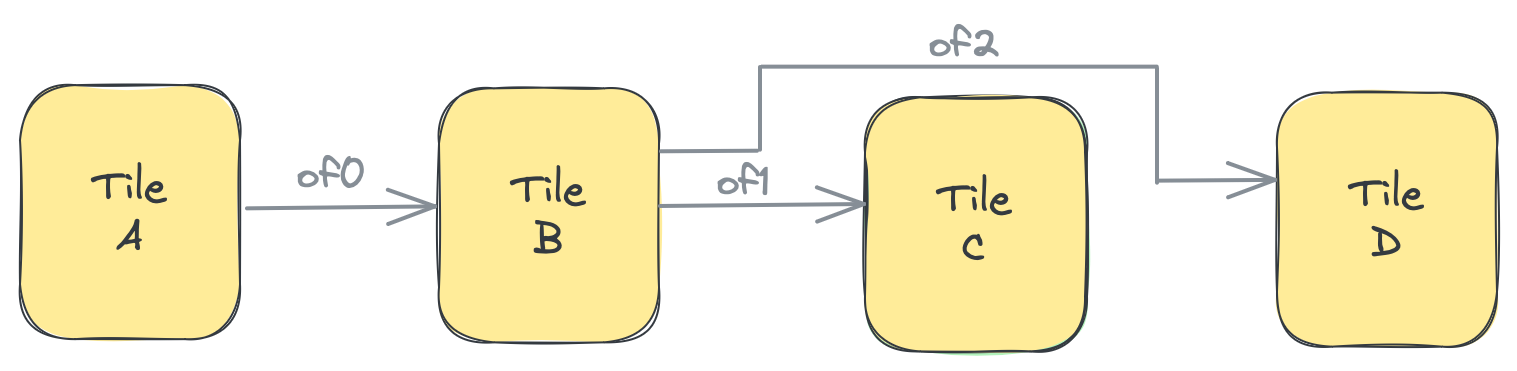
The following code snippet describes the figure above. There are three ObjectFifos: of0 has a producer tile A and a consumer tile B, while of1 and of2 have B as their producer tile and C and D respectively as their consumer tiles. The link specifies that data from of0 is distributed to of1 and of2. In this link, B is the shared tile where the implicit data copy will take place via B's DMAs. We can also note how of1 and of2's datatypes are half of of0's, which means that the first half of objects in of0 will go to of1 and the second half to of2, based on their order in the link. This is explicitly set by specifying the dstOffsets option on the link.
A = tile(1, 0)
B = tile(1, 1)
C = tile(1, 3)
D = tile(2, 3)
of0 = object_fifo("objfifo0", A, B, 2, np.ndarray[(256,), np.dtype[np.int32]])
of1 = object_fifo("objfifo1", B, C, 2, np.ndarray[(128,), np.dtype[np.int32]])
of2 = object_fifo("objfifo2", B, D, 2, np.ndarray[(128,), np.dtype[np.int32]])
object_fifo_link(of0, [of1, of2], [], [0, 128])
A full design example that uses this feature is available in Section 2f: 04_distribute_L2.
Join
The join pattern is the opposite of the distribute pattern where data received from multiple ObjectFifos is joined and sent to a single output ObjectFifo. This can be done with the join() function (defined in objectfifo.py):
def join(
    self,
    offsets: list[int],
    tile: Tile | None = AnyMemTile,
    depths: list[int] | None = None,
    obj_types: list[type[np.ndarray]] | None = None,
    names: Sequence[str | None] | None = None,
    to_stream: Sequence[TensorAccessPattern | None] | None = None,
    from_stream: Sequence[TensorAccessPattern | None] | None = None,
    plio: bool = False,
) -> list[ObjectFifo]
join() function creates multiple producer ObjectFifos to which the user can additionally specify the same inputs as to a regular ObjectFifo. The offsets are used to specify to which location in the producer ObjectFifo's allocated memory to write data from each producer ObjectFifo.
Below you can see an example of 2 ObjectFifo's being created and joined in the producer ObjectFifoHandle of of0. The join() function is additionally given the offsets from which data will be written by each producer ObjectFifo, the datatype of their objects, and their names.
of0 = ObjectFifo(mem_tile_ty, name="objfifo0")
n_cores = 2
of_offsets = [
    (np.prod(np_ndarray_type_get_shape(mem_tile_ty)) // n_cores) * i
    for i in range(n_cores)
]
of0_fifos = of0.prod().join(
    of_offsets,
    obj_types=[aie_tile_ty] * n_cores,
    names=[f"objfifo{i}" for i in range(n_cores)],
)
ObjectFifoHandles of type producer can be joined. The obj_types of the input FIFOs should be of a smaller size than the output one, and the sum of the sizes of the input FIFOs should be equal to the size of the obj_type of the output FIFO.
The join pattern with the link will have multiple input ObjectFifos and a single output ObjectFifo. With this pattern the user can combine the smaller inputs from multiple sources into a single bigger output data movement. The datatype of the input FIFOs should be of a smaller size than the output one, and the sum of the sizes of the input FIFOs should be equal to the size of the datatype of the output FIFO.
Similarly, the order in fifoIns specifies which input object will make up which part of the larger objects of the output ObjectFifo. To achieve the join, the lowering will use one input port of the shared tile to establish a connection per input FIFO, as in the figure below:
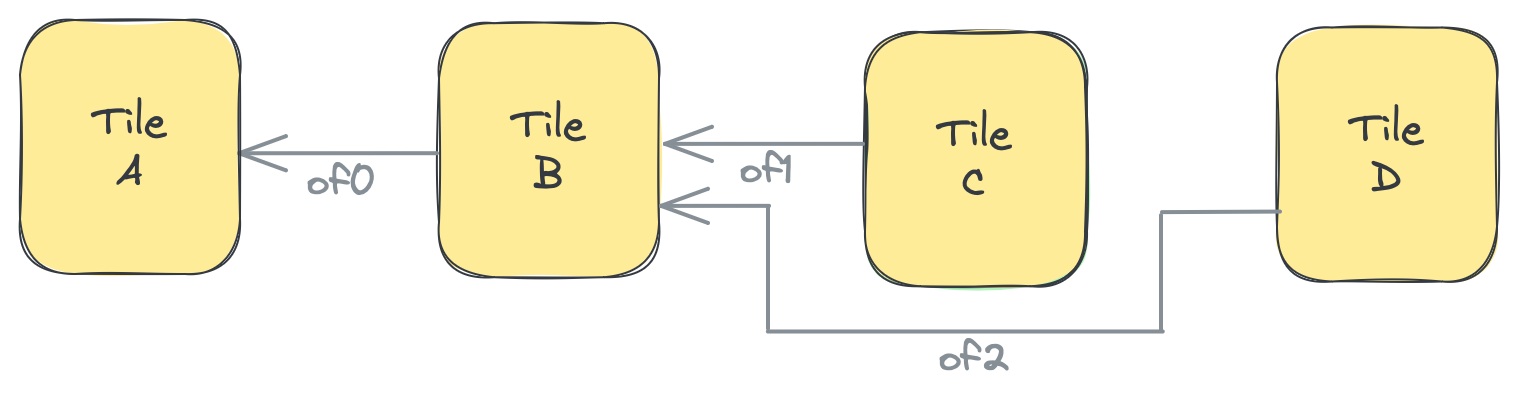
The following code snippet describes the figure above. There are three ObjectFifos: of0 has a producer tile B and a consumer tile A, while of1 and of2 have C and D respectively as their producer tiles and B as their consumer tile. The link specifies that data from of1 and of2 is joined into of0. In this link, B is the shared tile where the implicit data copy will take place via B's DMAs. We can also note how of1 and of2's datatypes are half of of0's, which means that objects from of1 will become the first half of objects in of0 while objects in of2 will become the second half, based on their order in the link.
A = tile(1, 0)
B = tile(1, 1)
C = tile(1, 3)
D = tile(2, 3)
of0 = object_fifo("objfifo0", B, A, 2, np.ndarray[(256,), np.dtype[np.int32]])
of1 = object_fifo("objfifo1", C, B, 2, np.ndarray[(128,), np.dtype[np.int32]])
of2 = object_fifo("objfifo2", D, B, 2, np.ndarray[(128,), np.dtype[np.int32]])
object_fifo_link([of1, of2], of0, [0, 128], [])
A full design example that uses these features is available in Section 2f: 05_join_L2.