Join in L2
The design in join_L2.py has three Workers where each one sends 8xi32 pieces of data to L2 via one of three ObjectFifos. There, the data is joined together into 24xi32 tensors based on the offsets for each ObjectFifo. The data is then sent out to external memory using of_out.
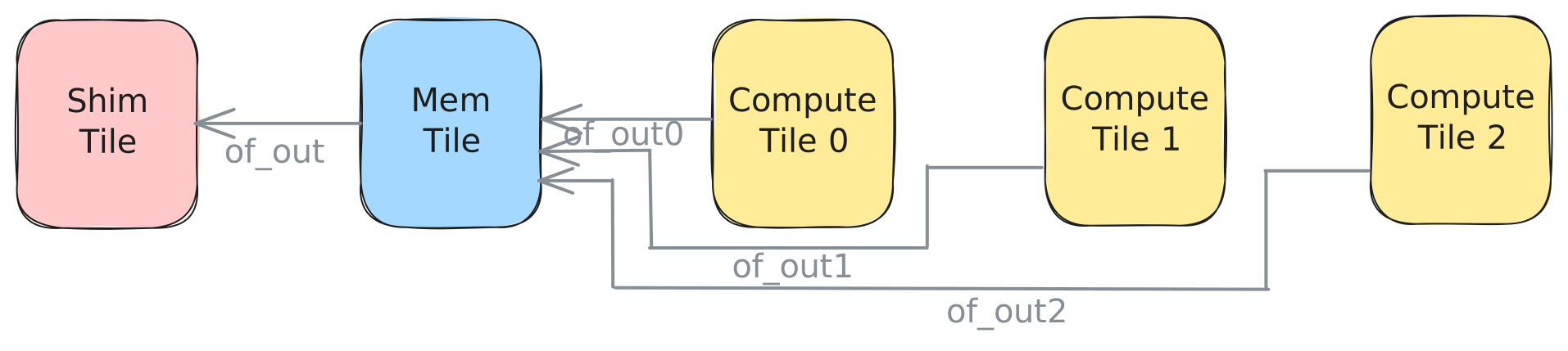
# Dataflow with ObjectFifos
# Output
of_offsets = [8 * worker for worker in range(n_workers)]

of_out = ObjectFifo(tile24_ty, name="out")
of_outs = (
    of_out.prod().join(
        of_offsets,
        obj_types=[tile8_ty] * n_workers,
        names=[f"out{worker}" for worker in range(n_workers)],
    )
)
All Workers are running the same process of acquiring one object from their respective input ObjectFifos to produce, writing 1 to all of its entries, and releasing the object.
This design is combined with the previous distribute design to achieve a full data movement from external memory to the AIE array and back. The resulting code is available in distribute_and_join_L2.py, wrapped in @iron.jit so a single command JIT-compiles and runs it on the attached NPU:
python3 distribute_and_join_L2.py
python3 distribute_and_join_L2.py --dev npu --emit-mlir > aie.mlir
python3 join_L2.py --dev npu --emit-mlir > aie_join.mlir
The # To/from AIE-array data movement section of the design code is described in detail in Section 2d.
NOTE: The design in distribute_and_join_L2.py takes ext_to_core_L2 and distributes smaller pieces of the input data to three Workers. This pattern is typically used when the input data is too large for a single core's memory module and needs to be processed in smaller chunks, the result of which is then joined together to produce the final output.
Other examples containing this data movement pattern are available in the programming_examples. A notable one is vector_exp.