ObjectFifo Repeat Pattern
At the closer-to-metal API level, the ObjectFifo provides users with two ways to specify how data from the producer should be repeated.
Both repeat features are achieved using the Direct Memory Access (DMA) unit of the ObjectFifo's producer tile. In particular, data movement for each DMA channel is described as a chain of buffer descriptors, where each buffer descriptor (BD) indicates what data should be pushed to the AXI stream. The data movement generated for ObjectFifos follows a cyclic pattern of First In First Out where each object in the ObjectFifo is moved by one BD in a chain.
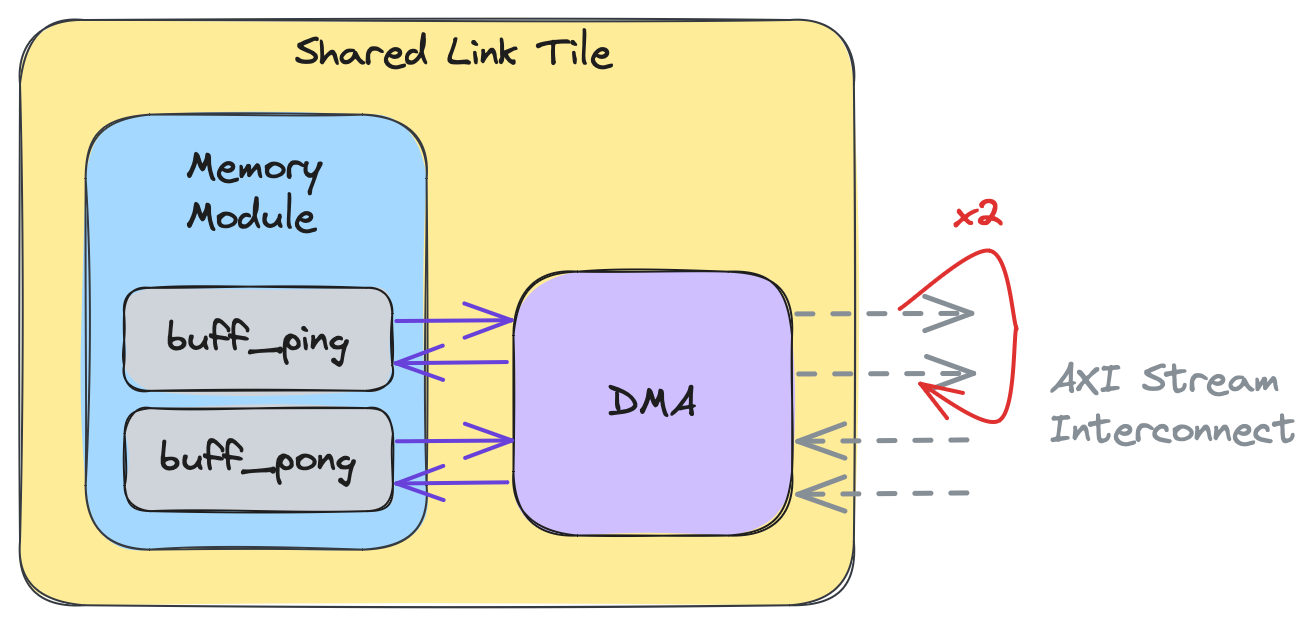
The first repeat features enables users to repeat the entire BD chain using the following syntax:
of0 = object_fifo("objfifo0", A, B, 2, np.ndarray[(256,), np.dtype[np.int32]])
of0.set_iter_count(2)
buff_ping - buff_pong - buff_ping - buff_pong. This is shown in the figure below with the red arrow representing the repeat value of the entire BD chain:
NOTE: Repeating BD chains is only available on Mem tiles.
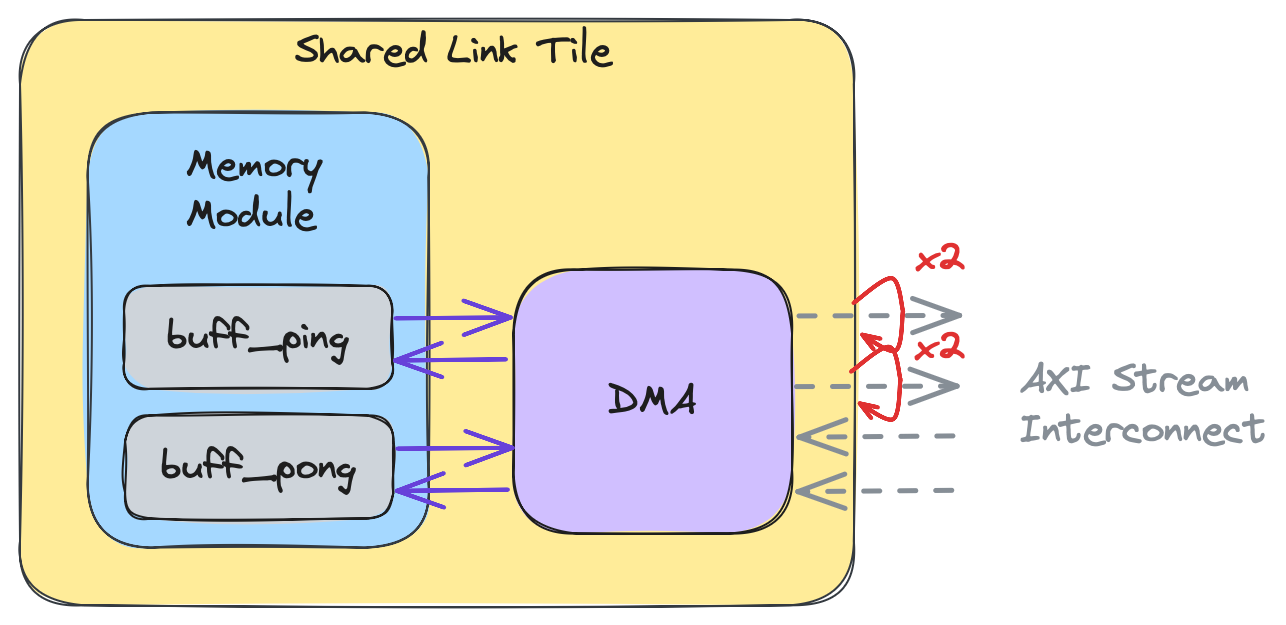
Users may also repeat each individual BD in the chain. This feature is available using the following syntax:
of0 = object_fifo("objfifo0", A, B, 2, np.ndarray[(256,), np.dtype[np.int32]])
of0.set_repeat_count(2)
buff_ping - buff_ping - buff_pong - buff_pong. This is shown in the figure below with the red arrows representing the repeat values of each BD in the chain:
The repeat_count feature may also be used with a Compute tile producer. As synchronization logic is leveraged for object accesses between a Compute tile core and its DMA, the ObjectFifo lowering will use available information to modify the values of ObjectFifo acquire and release operations based on the repeat value. This is to ensure that enough tokens are produced by the compute core to allow the DMA to repeat and that these tokens are accounted for by the first acquire operation post DMA repetition. Doing this adjustement for ObjectFifos of depth larger than 1 is non-trivial and currently not supported.
NOTE: The two repeat features can be combined.
NOTE: No additional memory is allocated when repeating. Instead, DMAs are programmed to push existing data buffers multiple times.
For more information into DMAs and their buffer descriptors you can refer to the Advanced Topic of Section 2a and Section 2g.
Link & Repeat
It is also possible to use repetition with the link, described in the previous section, using the following syntax:
of0 = object_fifo("objfifo0", A, B, 2, np.ndarray[(256,), np.dtype[np.int32]])
of1 = object_fifo("objfifo1", B, C, 2, np.ndarray[(256,), np.dtype[np.int32]])
object_fifo_link(of0, of1)
of1.set_repeat_count(2) # the data in each object is sent to the consumer C twice
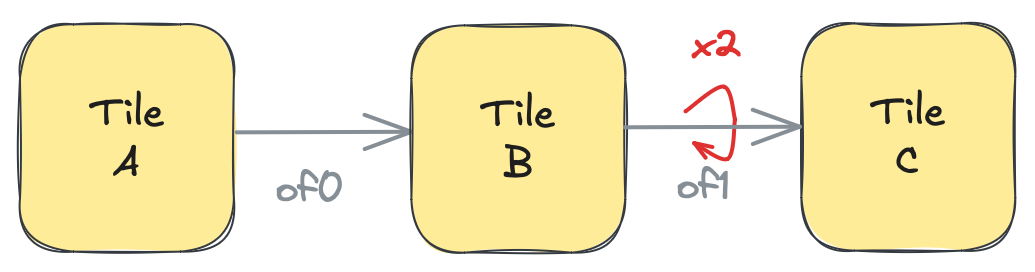
In this case the repetition is achieved using the Direct Memory Access (DMA) of the ObjectFifo link's shared tile.
In particular, the repeat functionality can be used in conjunction with the distribute pattern introduced in the previous section. Currently, the repeat value specified for each distribute destination must be the same to ensure functional correctness. Additionally, the syntax currently doesn't support both output ObjectFifos with repeat and without at the same time, in the same distribute pattern. The code below shows how the two output ObjectFifos of a distribute pattern can be set to each repeat three times:
of0 = object_fifo("objfifo0", A, B, 2, np.ndarray[(256,), np.dtype[np.int32]])
of1 = object_fifo("objfifo1", B, C, 2, np.ndarray[(256,), np.dtype[np.int32]])
of2 = object_fifo("objfifo2", B, D, 2, np.ndarray[(256,), np.dtype[np.int32]])
object_fifo_link(of0, [of1, of2])
of1.set_repeat_count(3)
of2.set_repeat_count(3)